

“Both say Colombia. So why is one RM60 for 500 g, and the other RM75 for just 250 g?”
A customer asked me this while holding two of our bags side by side. It’s a fair question. And the answer is the key to finding the best Colombian coffee for you.
The label tells the story: region, grade, process, roast level, and roast date. Once you know how to read it, choosing high-quality Colombian coffee gets easy. Here’s my simple checklist for finding the best Colombian coffee, with charts, real label examples, and a few lessons I learned along the way.
Table of Contents
Colombia is one of the world’s great coffee origins.
According to the USDA’s 2026/27 forecast, Colombia will produce about 13.4 million 60-kg bags of coffee. That makes it the world’s third-largest producer, behind Brazil and Vietnam, with roughly 7% of global output.
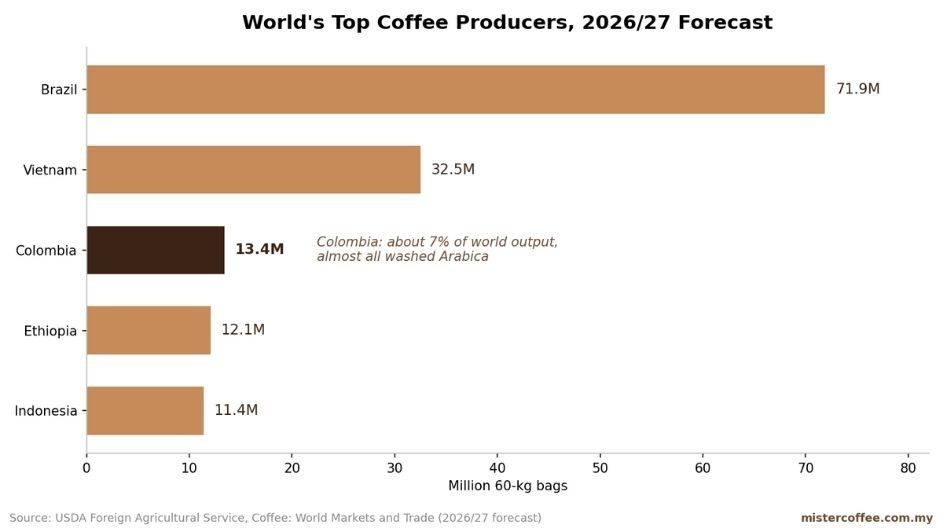
Colombia is the third-largest coffee producer and a leading source of washed Arabica. Source: USDA Foreign Agricultural Service.
But size isn’t the main story. Quality is.
Colombian coffee beans are almost entirely Arabica, and most are washed. That’s what gives Colombian coffee its famous clean, bright and balanced cup.
According to the Colombian Coffee Growers Federation (FNC), more than 500,000 families grow coffee across 23 departments. Many farms are small. Many sit high in the Andes, often between 1,200 and 2,000 meters. And many regions enjoy two harvests a year, a main crop and a smaller “mitaca” crop.
All that diversity is wonderful. It also means two bags that both say “Colombia” can taste completely different. That’s why learning how to choose Colombian coffee beans really pays off.
You don’t need a history degree to buy the best Colombian coffee. But a little Colombia coffee history explains why the name carries so much trust.
Coffee is believed to have arrived in Colombia with Jesuit missionaries in the 1700s. By the 1830s, the country was exporting it.
In 1927, growers founded the National Federation of Coffee Growers (FNC). It still sets the grading standards you’ll see on bags today.
In 1958, the FNC introduced Juan Valdez, the friendly farmer with his mule. He became one of the most famous faces in coffee.
In 2007, “Café de Colombia” gained Protected Geographical Indication status in the European Union. And in 2011, UNESCO listed the Coffee Cultural Landscape of Colombia as a World Heritage Site.
That’s almost a century of building a reputation for quality. The best Colombian coffee lives up to it. Your job is simply to find those bags.
Here’s the checklist I use whenever I’m choosing the best Colombian coffee beans, whether for my own kitchen or for a friend. (Shopping for other origins too? Our general guide on how to choose coffee beans covers the basics.)
This is my number one rule. Even the best Colombian coffee tastes flat when it’s stale.
Look for a roast date, not just a “best before” date. Once a bag of whole beans is open, I aim to finish it within about two to four weeks for the best aroma.
Packaging matters too. At Mister Coffee, our beans are sealed using Modified Atmosphere Packaging (MAP), which reduces oxygen inside the pack to below 1% within days of packing. That helps fresh roasted Colombian coffee beans keep their aroma until you open them.
Once opened, the clock starts. I write the opening date on every bag with a marker. It sounds fussy, but it stops me from brewing a sad cup from a bag I forgot about.
If you can, buy whole beans and grind just before brewing. Ground coffee loses aroma much faster.
Want more on freshness? Read our guide to freshly roasted coffee beans.
“100% Colombian” is a good start. But the best Colombian coffee often names a specific region, town or even farm.
Here are the Colombian coffee-growing regions you’ll see most often:
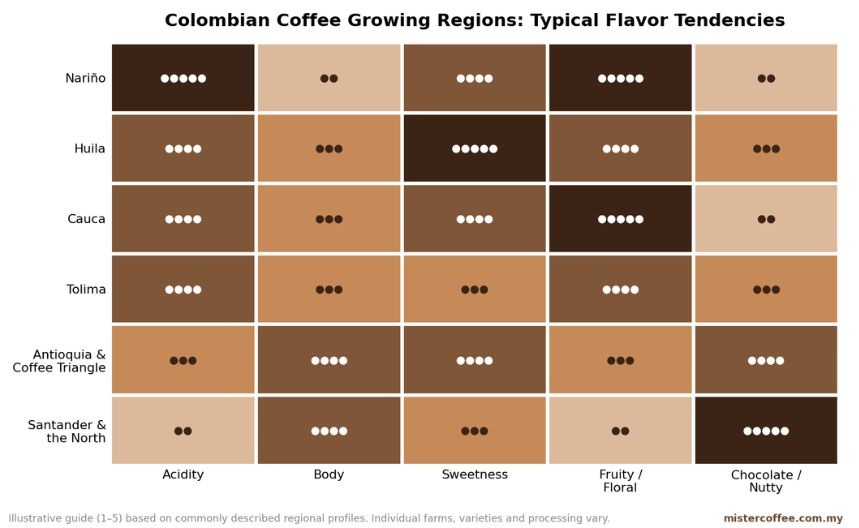
Typical tendencies only. Individual farms, varieties, and processing can change the cup a lot.
These are tendencies, not rules. I was reminded of this at one of our cupping sessions. I expected the Antioquia lot to taste nutty and chocolatey. Instead, our Finca Bella Vista from Urrao, Antioquia, tasted of red berries and jasmine. High altitude and careful processing changed everything.
So use regions as a guide to the best Colombian coffee for your taste. Then let the rest of the label fill in the details.
You’ll often see “Supremo” or “Excelso” on Colombian bags. These Colombian coffee grades are about bean size, measured with screens.
One screen equals 1/64 of an inch. According to the FNC, Supremo beans are retained by screen 17 or 18. Smaller grades like Extra (screen 16), Europe (screen 15), and UGQ (screen 14) are usually exported as Excelso.
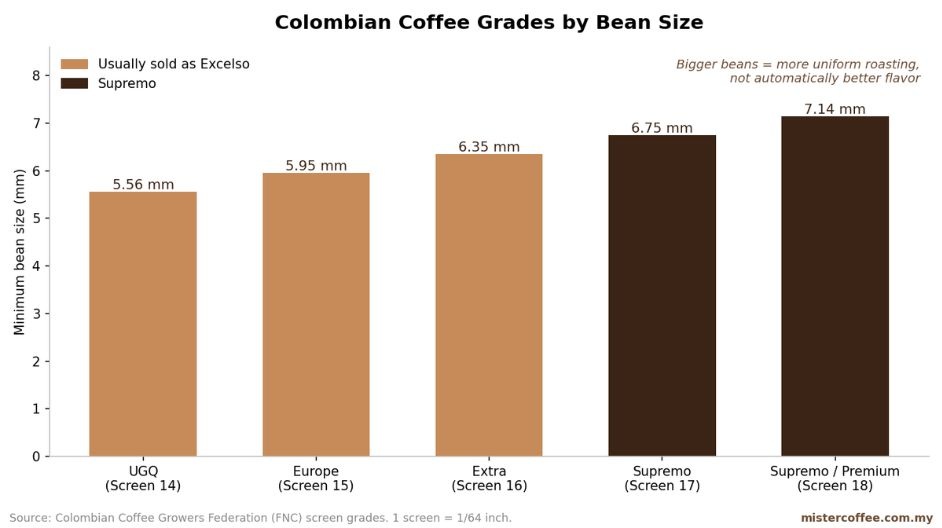
Supremo beans are only about 1 to 1.5 mm larger than the smallest Excelso grade. Source: FNC screen grades.
So, Supremo vs. Excelso coffee: which is better?
Honestly, neither by default. Bigger, more uniform beans can roast more evenly. But size doesn’t guarantee flavor.
I learned this the expensive way. Early in my coffee journey, I paid extra for a “Supremo” bag because it sounded premium. Later, I tasted it next to an Excelso from a well-known farm. The Excelso was sweeter, cleaner, and far more interesting. Bigger beans didn’t mean the best Colombian coffee.
You may also see “EP,” which stands for European Preparation. It means the green beans were carefully hand-sorted to remove defects. That’s a good sign.
My advice? When you’re hunting for the best Colombian coffee, treat grade as a bonus. Region, freshness, and processing tell you more.
Processing is what happens after the coffee cherry is picked. It has a big effect on taste.
Some Colombian farms now experiment with long fermentation. Our Finca Bella Vista and Finca La Illusion lots, for example, are washed with a long fermentation of about 96 hours. The result is a richer, more aromatic cup.
If you’re new, start your search for the best Colombian coffee with a washed lot. It’s the clearest way to taste what the origin is all about.
Colombian Arabica coffee beans come in many varieties. Common ones include Castillo, Caturra, Colombia, Typica and Bourbon. Castillo was developed in Colombia to resist coffee leaf rust, and it’s widely grown today.
You might also see rarer names. Caturra Chiroso, for instance, is a variety found in Antioquia and known for citrus and floral aromas.
Altitude matters too. Higher farms are cooler, so cherries ripen slowly. That often means denser beans with more acidity and complexity.
Our Finca La Illusion grows at 2,060 meters above sea level. You can taste that height in its tropical fruit and candied fruit notes.
Still, the best Colombian coffee isn’t about exotic names or big numbers alone. A well-grown Castillo can beat a poorly handled rare variety.
The best Colombian coffee for you depends heavily on roast level. Here’s how Colombian coffee roast levels typically change the cup.
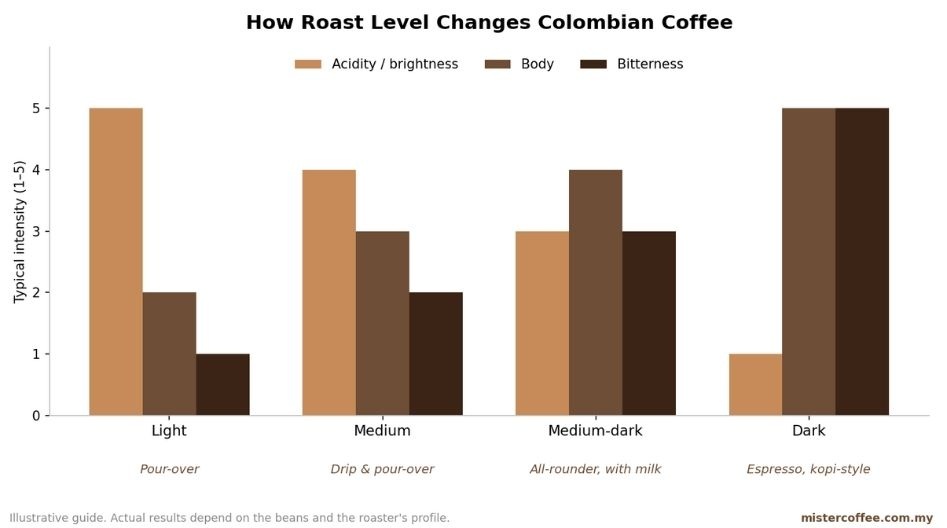
General guide. Every bean and roast profile is a little different.
Here’s something I love about Colombian beans. They hold their brightness well. Our everyday Colombia (500g) is a medium-dark roast, yet it still carries an acidity rating of 4 out of 5, with mild citrus and fruity notes.
My mom, on the other hand, drinks her coffee with milk every morning. She prefers a darker roast because it stands up to the milk. Same origin, different roast. The best Colombian coffee for her isn’t the best for me, and that’s fine.
For a deeper comparison, see our guide to medium vs. dark roast coffee.
The classic Colombian coffee flavor profile is clean and balanced. Expect caramel, milk chocolate, nuts, citrus, and red fruit, with a medium body and a smooth finish.
Tasting notes help you find the best Colombian coffee for your preference. They don’t prove quality.
Not sure what all those words mean? Our guide to coffee flavor notes breaks them down simply. If you lean toward cocoa, you might also enjoy our list of coffee with chocolate notes.
Let’s put the checklist to work and spot the best Colombian coffee on the shelf. Here’s how to identify quality coffee beans by comparing two kinds of labels.
| What the label says | Vague label | Traceable label (our Finca Bella Vista) |
|---|---|---|
| Origin | “Premium Colombian” | Colombia, Antioquia, Urrao |
| Producer | Not listed | Carmen Cecilia Montoya, 4-hectare farm |
| Variety | Not listed | Arabica (Caturra Chiroso) |
| Altitude | Not listed | 1,950–2,050 meters |
| Process | Not listed | Washed, long fermentation (over 96 hours) |
| Roast | “Rich roast” | Medium |
| Tasting notes | “Smooth and bold” | Red berries, jasmine, honey |
The traceable label tells you who grew the coffee, where, how and what it should taste like. That’s what high-quality Colombian coffee looks like on paper.
The best Colombian coffee should also look and smell right. Check the beans themselves:
To learn how to identify high-quality roasted coffee beans, check out our guide for a full walkthrough.
Comparing origins is one of the fastest ways to find the best Colombian coffee for your taste. Here are the comparisons I’m asked about most.
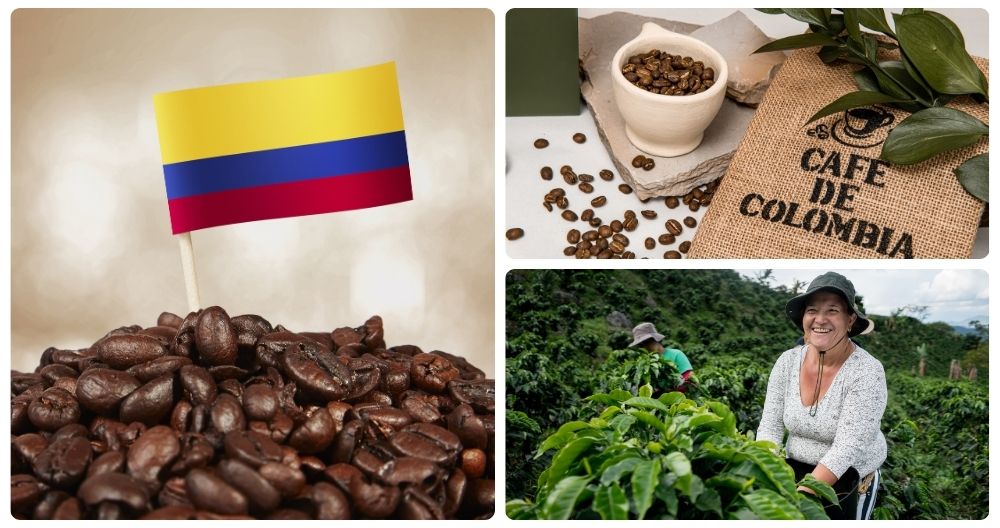
This one confuses many people. Arabica is a coffee species. Colombian is an origin.
So it’s not really “Arabica vs Colombian coffee.” Colombian coffee is Arabica coffee, grown in Colombia. If you see both words on a bag, it simply means Colombian Arabica coffee beans.
Want to understand the species side? Read our guide to Arabica vs Robusta coffee beans, or try our Arabica (500g) for comparison.
Brazil is the world’s largest producer. Many Brazilian coffees grow at lower altitudes and are often processed naturally or pulped naturally.
The result? Brazil tends to be nutty, chocolatey, low in acidity, and heavy in body. Colombia tends to be brighter, cleaner, and more fruity.
Try them side by side with our Brazil (500g) and Colombia (500 g). It’s a fun weekend experiment.
These two are close cousins. Both are washed, high-grown Arabicas with lively acidity.
Guatemalan coffee often has a fuller body, with chocolate and gentle spice notes. Colombian coffee is usually a little softer and sweeter, with more caramel and citrus. Compare with our Guatemala (500g).
This is the biggest contrast of the four.
Sumatra is usually wet-hulled, a local process that creates an earthy, herbal cup with low acidity and heavy body. Colombian coffee is clean, bright, and balanced.
If you love one, you might not love the other. Our Sumatra (500g) is a great way to taste the difference. Our guide to Indonesian coffee beans explains more.
| Origin | Typical acidity | Typical body | Typical flavors |
|---|---|---|---|
| Colombia | Medium to bright | Medium | Caramel, citrus, red fruit, chocolate |
| Brazil | Low | Medium to full | Nuts, chocolate, caramel |
| Guatemala | Bright | Medium to full | Chocolate, spice, citrus |
| Sumatra | Low | Full | Earthy, herbal, spicy |
Taste a few origins side by side, and you’ll quickly know whether the best Colombian coffee is your everyday cup or your weekend treat.
Even the best Colombian coffee needs the right brewer. Here’s how I match them.
Pour-over: Choose a light or medium roast, ideally a washed, single-origin Colombian coffee. This is where the best Colombian coffee shows its fruity and floral side. Our guide on how to make pour-over coffee will help you get started.
French press and drip machines: Medium to medium-dark roasts work beautifully in a French press. You get body, sweetness, and a little brightness. Here’s our guide to using a French press with ground coffee.
Espresso: Colombian coffee beans for espresso are usually roasted medium-dark or darker. This keeps the shot sweet and rounded, not sour. Our Colombia (500 g) works well for espresso, drip, and French press. Curious how espresso changes flavor? Read about the difference between espresso and filter coffee.
No equipment at all: This is where our single-serve formats shine.
I keep a box of BagBrew Colombia Dark Roast in my office drawer. You just steep the bag in hot water for three to five minutes, like tea. It’s bold, full-bodied, and low in acidity, which suits my afternoon slump perfectly.
When I want something lighter, I reach for DripBrew Colombia. It’s mild, citrusy, and aromatic. Here’s our DripBrew brewing guide and our BagBrew guide.
If you’re looking for a Colombian coffee brand option in Malaysia, we offer Colombian coffee in several formats. Here’s a quick guide to help you choose the best Colombian coffee for your routine.
| Product | Roast | Flavor | Best for |
|---|---|---|---|
| Colombia (500g) | Medium-dark | Mild citrus, fruity, smooth medium body | Everyday drinking: drip, French press, espresso |
| Finca Bella Vista, Medium | Medium | Red berries, jasmine, honey | Pour-over, specialty lovers |
| Finca Bella Vista, Medium ++ | Medium ++ | Red berries, jasmine, honey | Pour-over or a slightly rounder cup |
| Finca La Illusion | Medium | Tropical fruit, candied fruit, cocoa, caramel | Pour-over, gifting |
| DripBrew Colombia | n/a | Mild, citrusy, aromatic | Office and travel |
| BagBrew Colombia Dark Roast | Dark | Bold, full body, low acidity | Stepping, no equipment |
| PodBrew Colombia (10s) / (150s) | n/a | Classic Colombian cup | Soft-pod brewers like our Zest Pod Brewer |
Our traceable specialty lots are small and sell out quickly, so check availability on each product page. You can browse more in our Specialty Coffee & Traceability range, our Beans & Grounds collection, our DripBrew range, and our coffee pods. New to soft pods? Read about the Zest Pod Machine and PodBrew.
If you’ve been searching “Colombian coffee near me,” you have a few easy options.
Online: The simplest way to buy Colombian coffee is through our online shop. Free shipping applies from RM80 in Peninsular Malaysia, RM180 in East Malaysia and RM300 for Singapore. Our specialty Colombian lots are online exclusives.
In stores: Our store locator lists supermarkets and showrooms that carry Mister Coffee. Ranges vary by outlet, so check before you go. Our guide to supermarket coffee in Malaysia explains what to look for on the shelf.
Looking for more local options for Colombian coffee beans in Malaysia? These guides cover where to buy Colombian coffee beans and more, state by state:
The best Colombian coffee is only great if it reaches your cup fresh. Whichever route you choose, pick a Colombia coffee brand that shows the roast level, packs for freshness, and tells you where the beans come from.
So, how do you choose high-quality Colombian coffee beans?
Check the roast date. Look for a region. Treat grades as a bonus, not a guarantee. Choose a process and roast that match your taste and brewer. And trust labels that tell you more, not less. That’s how you find the best Colombian coffee.
As for that customer with two bags? I told him the RM60 Colombia is the one I’d drink every day. It’s balanced, reliable, and great value. The RM75 specialty lot is the one I’d open on a slow Sunday to taste a single farm’s story.
He bought both. Honestly, that’s my favorite answer. The best Colombian coffee isn’t one bag. It’s the right bag for the moment.
Happy brewing.
The best Colombian coffee is fresh, clearly labelled, and suited to your taste. Look for a named region, a washed process, a recent roast date, and tasting notes you enjoy.
Not necessarily. Supremo beans are larger (screen 17–18), and Excelso beans are smaller (usually screen 14–16). Size helps even roasting, but freshness, region, and processing matter more for flavor.
Medium is the most versatile. Choose light for pour-over and fruity notes, or medium-dark to dark for espresso and milk drinks.
Yes. The best Colombian coffee for espresso is usually roasted medium-dark or darker. It makes a sweet, balanced espresso with chocolate and caramel notes.
Once opened, aim to finish whole beans within about two to four weeks. Store them airtight, away from heat, light, and humidity.
You can buy Mister Coffee’s Colombian coffee online with free shipping thresholds, or check our store locator for selected supermarkets and showrooms.


My sister has exactly one coffee ritual: rip open a sachet, pour hot water, stir, done. No grinder, no scale,...
I still remember a regular at our café counter holding up two cups, sniffing each one, and asking me, half-joking,...
I still remember the first time someone handed me a cup of coffee and said, "you'll get notes of blueberry...
If you're anything like me, a proper brew is an essential part of your morning routine. Over the years, I’ve...
For a drink that has utterly transformed the way we enjoy our daily caffeine hit, it’s cold brew. There is...
There is nothing quite like waking up to the rich, inviting aroma of freshly roasted coffee filling your home. For...