

If you have ever wondered how to choose coffee beans without wasting money, you are in the right place.
I still remember my first “serious” bag of beans. It had a gorgeous label, a mountain on the front, and the words “premium roast” in gold. I paid a lot for it.
It tasted like burnt toast.
There was no roast date. No origin. No flavor notes. Just a pretty picture. That bag taught me more than any coffee class: the label matters, but only the right parts of it.
Today I taste coffee for a living at Mister Coffee. We have been roasting in Malaysia since 1982, and we source beans from more than 25 countries. People ask me every week how to choose coffee beans, and the honest answer is simple.
You only need to understand five things: the type of bean, the roast level, the origin, the freshness, and your brewing method.
That’s it. Once you know these, choosing a great coffee stops being a gamble.
In this guide, I’ll walk you through each one in plain language. I’ll also share the science behind it, with charts, so you can see why these rules work. By the end, you’ll know exactly how to choose coffee beans that suit your taste, your gear, and even your health goals.
Table of Contents
The first step in how to choose coffee beans is knowing which species you are buying.
There are many types of coffee drinks, from latte to kopi-o. But there are only a few types of coffee beans. Two of them make up almost everything you drink.
Arabica grows at higher altitudes. It tastes sweeter, softer, and more complex. Think fruit, flowers, caramel, chocolate.
Robusta is hardier and grows lower. It tastes bolder, earthier, and more bitter. It also gives espresso a thick, lasting crema.
Here’s the science behind the taste, and why it matters for how to choose coffee beans. Look at how differently the two species are built.
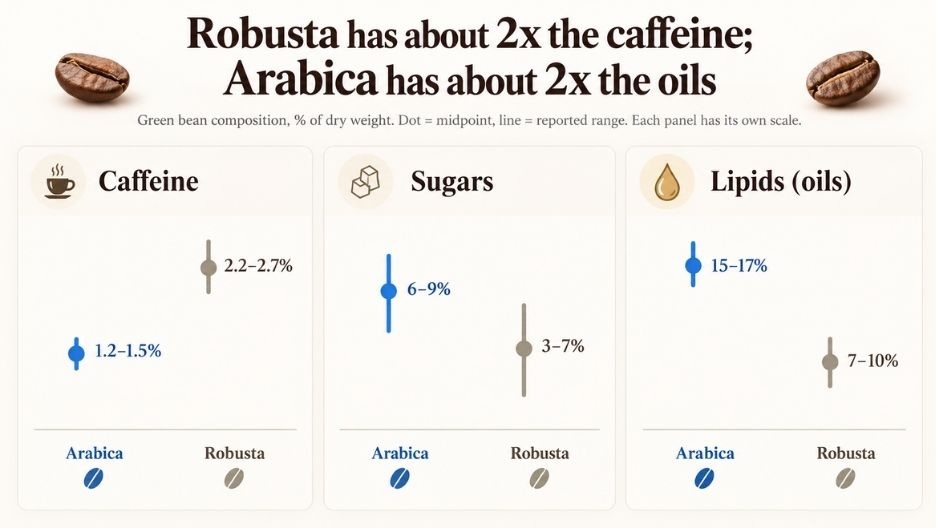
Ranges compiled from Lavazza, Barista Life and specialtycoffee.id composition data · green beans, dry weight
Caffeine is bitter, and it doubles as a natural pest shield for the Robusta plant. That’s one reason Robusta tastes stronger. Arabica, on the other hand, carries more sugars and oils, which turn into sweetness, aroma, and body during roasting.
So which is better? Neither, really. I drink both.
On slow weekend mornings, I brew a fruity Arabica as pour-over. On busy weekdays, I want a Robusta-heavy blend in my kopi with condensed milk. It wakes me up like nothing else.
If you want to dig deeper, read our full breakdown of Arabica vs Robusta coffee beans and why Robusta isn’t bad at all.
There are also two rarer species worth knowing: Liberica and Excelsa. Liberica is a Malaysian favorite, with a smoky, jackfruit-like character. You can learn more in our guide to buying Liberica coffee beans online and our overview of the different types of coffee beans.
Want to taste the species side by side? Our Species Series is built exactly for that.
My tip: if you are new and unsure how to choose coffee beans, start with 100% Arabica. If you love strong, bitter, milky coffee, try a blend with Robusta.
If I could teach a beginner only one thing about how to choose coffee beans, it would be this: roast level shapes flavor more than anything else on the bag.
The same green bean can taste like lemon tea or like dark chocolate. It all depends on how long and how hot it was roasted.
Here is the simple cheat sheet I give to friends:
| If you like… | Try this roast |
|---|---|
| Fruit, flowers, citrus, tea-like flavors | Light roast |
| Balance, sweetness, chocolate, nuts | Medium roast |
| Bittersweet, smoky, heavy body | Dark roast |
Light roast keeps the bean’s origin character. It’s bright, juicy, and sometimes surprising.
Medium roast is the friendly middle. It balances sweetness, acidity, and body. For most beginners, medium or medium-light is the best starting point.
Dark roast brings out the roast itself. Smoky, bold, low in acidity. It shines with milk and sugar.
Why do they taste so different? Chemistry. A 2023 study measured the acids in brewed coffee at three roast levels. The result is clear.
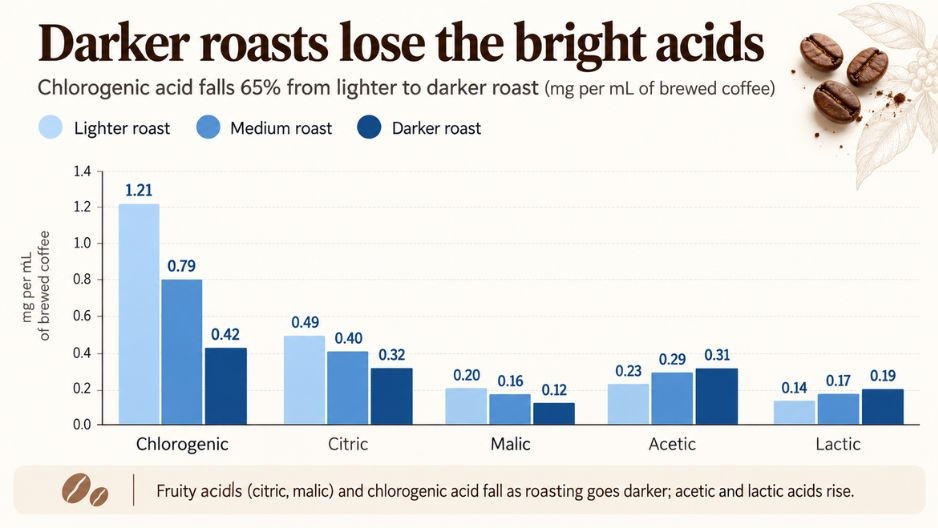
Source: Acids in brewed coffees, Current Research in Food Science (2023), Table 2 · mean acid concentration by roast level
Those fruity acids are what we call “brightness.” As the roast gets darker, they break down. That’s why a dark roast tastes smoother and less sour, and why a light roast can taste like fruit.
One more thing surprised me when I started roasting. Roast names are not standardized. One roaster’s “medium” can be another roaster’s “medium-dark.” So always read the flavor notes too, not just the roast word.
I learned this the hard way. I once bought a “medium roast” from a new café that tasted almost charred. Now I check the notes first. If I see “dark chocolate, molasses, smoke,” I know what I’m getting.
Want the full comparison? Read our guide on medium vs dark roast coffee. And if you love bold, smoky cups, browse our Dark Roast Series.
Origin is the next clue in how to choose coffee beans. Soil, altitude, rain, and local farming all leave a fingerprint in the cup.
You don’t need to memorize a world map. Just learn a few big flavor “families.” Here’s the quick version I use when friends ask me for the best coffee beans to start with:
| Origin | Typical flavor notes | Good for… |
|---|---|---|
| Ethiopia | Blueberry, jasmine, lemon, bergamot | Fruity, floral pour-over lovers |
| Kenya | Blackcurrant, berry, juicy acidity | People who like bright, wine-like cups |
| Colombia | Caramel, nuts, red apple | A balanced, sweet everyday coffee |
| Brazil | Chocolate, peanut, low acidity | Espresso and milk drinks |
| Guatemala | Cocoa, brown sugar, soft fruit | Smooth, chocolatey cups |
| Indonesia (Sumatra, Java) | Earthy, herbal, spicy, heavy body | Bold, full-bodied coffee |
| Jamaica Blue Mountain | Mild, clean, very smooth | A special-occasion treat |
My personal story with origins started with Ethiopia. The first time I tasted a washed Yirgacheffe, I honestly thought someone had added tea to my coffee. Jasmine, lemon, a little honey. I was hooked.
If that sounds like you, start with our guide to the best Ethiopian Yirgacheffe coffee and Yirgacheffe flavors, or explore buying Ethiopian coffee beans.
If you grew up drinking strong kopi, you might feel more at home with Indonesian beans. They are earthy and heavy, and they love milk. Read more in our guide to Indonesian coffee beans.
Flavor notes are not added flavors. They are comparisons. “Blueberry” means the coffee reminds tasters of blueberry.
Here’s how I translate them:
Don’t obsess over a numeric score like “87 points.” A high score means tasters judged it high quality. It doesn’t mean you will love it. Ask yourself one question instead: does this description sound delicious to me?
Our coffee flavor notes guide goes deeper. If you already know you love sweet, cozy cups, see our picks for coffee with chocolate notes and coffee with nutty notes.
To travel the world one bag at a time, try our Country Series. And if you want a once-in-a-while luxury, we also carry Jamaica Blue Mountain.
This is the fun part of learning how to choose coffee beans. Every new origin is a small trip.
Most beginners skip this part. Please don’t. Processing is a hidden key in how to choose coffee beans.
A coffee bean is actually a seed inside a red cherry. After harvest, farmers must remove the fruit and dry the seed. How they do it changes the taste a lot.
| Process | What happens | How it tastes |
|---|---|---|
| Washed | Fruit removed before drying | Clean, bright, crisp |
| Natural | Whole cherry dried in the sun | Fruity, sweet, sometimes wine-like |
| Honey | Some sticky fruit left on during drying | Sweet, syrupy, in-between |
| Anaerobic | Fermented in sealed tanks | Wild, intense, very fruity |
Here’s an experiment that taught me how to choose coffee beans by process. Buy the same origin in two processes, one washed and one natural. Brew them side by side.
The first time I did this with two Ethiopian coffees, I could not believe they came from the same region. The washed one tasted like lemon tea. The natural one tasted like strawberry jam.
My advice for a first bag: choose washed. It’s cleaner and easier to understand. Once you know what you like, try a natural or honey. Save anaerobic coffees for later. They are exciting, but they can taste funky to a new palate.
If you want to train your palate properly, join one of our coffee cupping workshops. Tasting with others is the fastest way to learn how to choose coffee beans with confidence.
Here’s the truth: even the best coffee beans in the world taste flat when they’re stale. Freshness is the most underrated part of how to choose coffee beans.
Roasting creates a lot of carbon dioxide (CO2) inside the bean. Around 1% of freshly roasted coffee’s weight is CO2. As it slowly escapes, it carries aroma with it.
Scientists at the Zurich University of Applied Sciences weighed beans on ultra-precise scales to track this gas loss. Based on that research, the Specialty Coffee Association suggests whole beans can reasonably be called fresh for about three weeks after roasting.
Ground coffee is a different story.
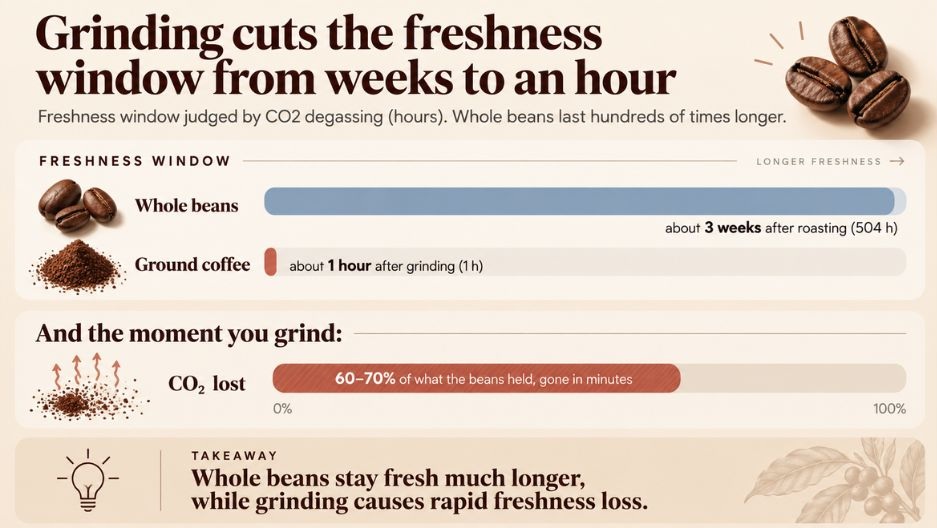
Sources: SCA Coffee Decoded, “What is fresh coffee?” (whole bean ~3 weeks, ground ~1 hour); Chahan Yeretzian via Perfect Daily Grind (60–70% of retained CO2 lost on grinding)
When you grind, you expose thousands of tiny surfaces at once. What whole beans lose over weeks, ground coffee loses in minutes.
So my first rule for how to choose coffee beans is simple. Look for a clear “roasted on” date. A “best before” date a year away tells you almost nothing.
This surprises people. Beans straight out of the roaster can taste sharp and gassy. Many coffees taste better after resting a few days. Espresso beans often like a little longer.
At home, I usually open a new bag about four or five days after the roast date. Then I enjoy it over the next two to three weeks.
If you change only one habit after reading this, make it this one. Buy whole beans and grind just before you brew.
I resisted for years because pre-ground felt easier. Then a friend made me two cups of the same coffee, one from a fresh grind and one pre-ground from last week. The difference was embarrassing. The fresh cup smelled like caramel and fruit. The old one smelled like cardboard.
A burr grinder gives an even grind and a cleaner cup. You can find options in our coffee grinder range.
In humid Malaysia, this matters even more. I keep my beans in a valve bag, rolled tight, inside a cupboard away from the kitchen window.
To learn more, read our article on freshly roasted coffee beans and how to identify high-quality roasted coffee beans.
The best beans for espresso are not always the best beans for pour-over. Your gear matters. This is the step many guides on how to choose coffee beans forget.
Each method pulls out different things. Espresso uses pressure and a fine grind, so it intensifies body and bitterness. Pour-over is clean and gentle, so it shows off delicate aromas and acidity. French press is full and rich, because the oils stay in the cup.
Here’s the match-up I recommend. It’s the heart of how to choose coffee beans for home brewing:
| Brewing method | Best roast | Great bean choices |
|---|---|---|
| Espresso | Medium to medium-dark | Brazil, Colombia, or an espresso blend (with a little Robusta for crema) |
| Pour-over (V60, Chemex) | Light to medium-light | Ethiopia, Kenya, washed Colombia |
| French press | Medium to dark | Sumatra, Guatemala, Brazil |
| Drip machine | Medium | Colombia, Central American blends |
| Cold brew | Medium to dark | Brazil, Colombia, chocolatey blends |
| Moka pot / kopi | Dark | Robusta blends, traditional kopi roasts |
When I bought my first home espresso machine, I used a beautiful light-roast Kenyan. I was so excited.
Every shot came out sour enough to make my face scrunch. I blamed the machine for a week. Then I switched to a medium-roast espresso blend, and the same machine made a sweet, syrupy shot.
The machine wasn’t the problem. My beans just didn’t match my method.
If you’re brewing pour-over, start here and adjust to taste:
Explore more in our guides: how to make pour-over coffee, how to use a French press, how to make a good cup of espresso, the best coffee beans for cold brew, and our overview of coffee brewing techniques.
For espresso lovers, our Espresso Series is roasted with crema and sweetness in mind. If you love Malaysian-style kopi, see our traditional kopi-o range.
And if you have no gear at all? No problem. Our Drip Brew and BagBrew packs let you enjoy freshly ground coffee with just hot water. I keep a few in my bag for travel.
A lot of readers ask me how to choose healthy coffee. The good news: plain black coffee is already a simple, low-calorie drink. But your choices can make it even better.
Here’s what the science says, in plain words.
Remember the roast chart above? Chlorogenic acid is coffee’s main antioxidant. It dropped by about two-thirds from light to dark roast in that 2023 study.
Other research agrees. One study found that light-roasted beans had the highest antioxidant activity, with a 40–80% loss as roasting continued. Caffeine, by contrast, stays fairly stable across roast levels.
So if health guides how to choose coffee beans for you, a light or medium roast is a smart pick.
Coffee contains natural oils called cafestol and kahweol. They can raise LDL, the “bad” cholesterol, if you drink a lot of unfiltered coffee. A paper filter catches most of these oils.
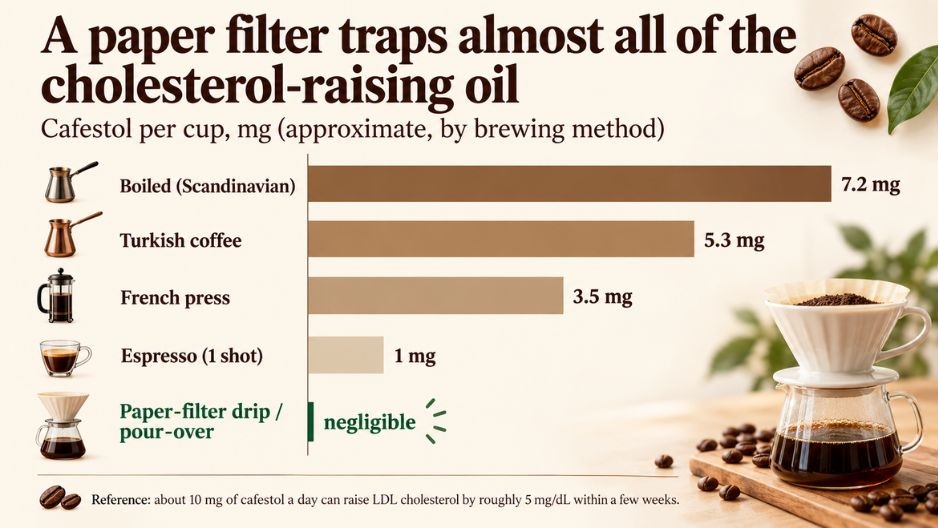
Sources: per-cup cafestol estimates summarized by Superpower Health from published studies; Urgert (1997), Wageningen University: diterpenes negligible in filtered and instant coffee
In a controlled Dutch trial, 63 mg of cafestol a day for four weeks raised cholesterol by 17%. That’s an extreme dose. But it shows why heavy drinkers of boiled or French press coffee should pay attention.
I love my French press. I still use it on weekends. But my everyday cup at work is paper-filtered pour-over. That’s my balance.
The beans are rarely the problem. The sugar, syrups, and creamers are. A spoon of sugar here and there is fine. Three pumps of syrup every day adds up fast.
Health authorities such as the US FDA suggest up to about 400 mg of caffeine a day is fine for most healthy adults. That’s roughly four cups of brewed coffee. If you’re sensitive, choose 100% Arabica or try decaf.
Read more in our articles on caffeine in coffee and what decaf coffee really is. You can also browse our decaf coffee range.
For many of our Malaysian readers, halal certification is part of choosing a coffee they can trust. Mister Coffee is halal-certified by JAKIM. Learn more about halal-certified coffee beans in Malaysia.
So when you think about how to choose coffee beans for health, keep it simple: light or medium roast, paper filter most days, and go easy on the sugar.
This section is general information, not medical advice. If you have a heart condition or high cholesterol, talk to your doctor about your coffee habits.
Now let’s put it all together. When you pick up a bag, the label is your map. Here’s the checklist I use every time I’m working out how to choose coffee beans from a new roaster.
The roaster matters as much as the bag. I trust roasters who:
You don’t need the most famous or most expensive roaster. Transparency and consistency are better signals than fancy packaging. Remember my gold-label disaster?
If you remember nothing else about how to choose coffee beans, remember this:
Recent roast date + clear origin + clear process + flavor notes you like + a roast that fits your brewer = a great bag of coffee.
That formula has never failed me. It turns choosing a great coffee from guesswork into a quick, five-second check.
One more tip: buy small. A 250 g bag is perfect when you’re exploring. You’ll finish it while it’s fresh, and you’ll learn faster by trying more coffees. That’s really the secret to how to choose coffee beans you’ll love: taste widely, take notes, and repeat what works.
When people type “best coffee near me” into Google, they usually mean a café. But the best coffee near you might be the one you brew at home with fresh beans.
Here’s where I’d look once you know how to choose coffee beans:
If you’re in Malaysia, our city guides make it easy: where to buy coffee beans in Kuala Lumpur, Selangor, Penang, Johor, and Sabah and Sarawak.
At Mister Coffee, we roast in Petaling Jaya on German roasting equipment, with beans sourced from more than 25 countries. Here’s where I’d point a beginner, based on what you’ve learned in this guide:
| If you want… | Start with |
|---|---|
| Fruity, floral, single-origin cups | Specialty Coffee Beans |
| To taste different countries | Country Series |
| To compare coffee species side by side | Species Series |
| Sweet, creamy espresso and lattes | Espresso Series |
| Bold, smoky, low-acid cups | Dark Roast Series |
| Less caffeine, same ritual | Decaf Coffee |
| Fresh coffee with zero equipment | Specialty Drip Bags |
You can see everything in our Beans and Grounds collection. If you’re still unsure how to choose coffee, message our team with your brewer and favorite flavors. We’ll suggest a bag. And if you want to know what sets a roaster apart, read our bean-to-cup journey.
Let’s recap how to choose coffee beans in one breath. Pick the species you like. Choose a roast that fits your taste. Explore origins and processes. Buy fresh, whole beans. Match them to your brewer.
That’s all there is to it.
The perfect coffee isn’t the most expensive one or the one with the highest score. It’s the one that makes you smile on your first sip in the morning.
My own perfect bag changes with my mood. Some weeks it’s a juicy Ethiopian. Some weeks it’s a chocolatey Brazil for my lattes. That’s the joy of it.
Now you know how to choose coffee beans like a pro. Go find yours, and enjoy every cup.
Start with a medium or medium-light roast, 100% Arabica, from a roaster that prints a roast date. Read the flavor notes and pick words that sound tasty to you. Then adjust from there.
Check the “roasted on” date. It’s the first thing to look at when you learn how to choose coffee beans. Whole beans are generally at their best within about three weeks of roasting. Fresh beans also smell strong and sweet when you open the bag.
Not really. Caffeine stays fairly stable during roasting. The bigger difference comes from the species: Robusta has roughly twice the caffeine of Arabica.
The four main types of coffee beans are Arabica, Robusta, Liberica, and Excelsa. Arabica and Robusta make up most of the coffee people drink.
Knowing how to choose coffee beans for health comes down to a few habits: choose a light or medium roast for more antioxidants, use a paper filter most days, and keep sugar and syrups low.
Whole beans, if you have a grinder. Ground coffee loses most of its freshness within about an hour. If you don’t have a grinder, buy small bags of ground coffee or try drip bags.
Buy only what you can finish in two to three weeks. For most home brewers, that’s a 250 g bag. Smaller bags also let you practice how to choose coffee beans more often.


The first time I brewed a proper Ethiopian Yirgacheffe, I genuinely thought I'd made a mistake. The cup smelled like...
I still remember the first time I made a latte at home that actually tasted like something from a café,...
I’ve been in the coffee industry for years and if there’s one thing I never get tired of, it’s watching...
Which coffee brewing method is best? The honest answer is, it depends on you and your lifestyle. Coffee brewing isn’t...
If you are a coffee lover, you probably have seen drip bags around. But did you know that the single-serve...
Latte art is a beautiful thing. You can be an art critic and still drink your coffee at the same...