

The first time I brewed a proper Ethiopian Yirgacheffe, I genuinely thought I’d made a mistake. The cup smelled like jasmine tea with a twist of lemon, and I kept checking the bag to make sure I hadn’t accidentally grabbed a tea sample instead of coffee. That confusion is exactly why I love introducing people to this origin.
As a coffee expert at Mister Coffee, I get asked constantly how to actually bring out Yirgacheffe coffee flavors at home, rather than brewing it the same way you’d brew a heavy, chocolatey Sumatra or a bold espresso blend. This guide walks through everything: what makes this coffee special, how to brew it properly, and which specific Yirgacheffe lots I’d point you toward if you want to taste this for yourself.
Table of Contents
Yirgacheffe coffee comes from a small growing area within the Gedeo Zone, in the Southern Nations, Nationalities, and Peoples’ Region of Ethiopia. It’s grown at high altitude, typically between 1,700 and 2,200 meters above sea level, on small family plots that farmers often call “garden coffee,” since it’s frequently intercropped with other food plants rather than grown on large single-crop farms.
Most Yirgacheffe coffee beans come from indigenous Ethiopian heirloom varieties, a genetically diverse pool that you genuinely don’t find replicated anywhere else in the world. That genetic diversity, combined with the altitude and the region’s volcanic soil, is a huge part of why this coffee tastes the way it does.
Within the wider region sit smaller, well-known kebeles and washing stations, places like Aricha, Chelchele, and Banko Gotiti, each producing subtly different lots depending on their specific microclimate and processing choices.
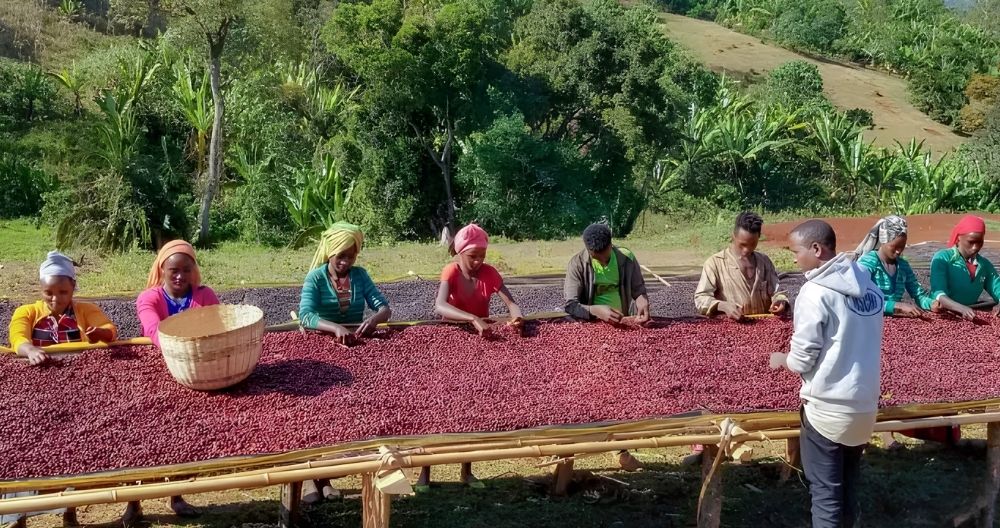
Yes, genuinely so. Most Yirgacheffe coffee grows under the canopy of indigenous trees like Acacia, Enset, and Cordia Africana, rather than in open, sun-exposed rows. Farmers plant coffee among other crops in what’s essentially a layered garden system, not a monoculture plantation.
This shade-grown approach slows the ripening of the cherries, which gives the beans more time to develop sugars and complex flavor compounds before harvest. It’s one of the quieter reasons this coffee tastes so refined.
Learn more: How Do I Identify High-Quality Roasted Coffee Beans?
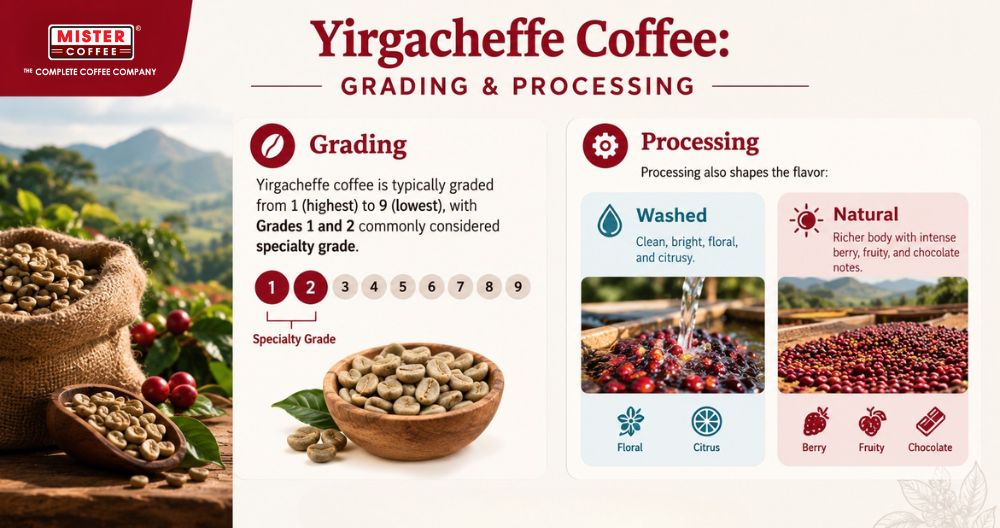
If you’ve seen labels like “Grade 1” or “Grade 2” on a bag and wondered what they mean, here’s the short version of the Yirgacheffe coffee specifications. Ethiopian coffee grading runs from 1 (highest) to 9 (lowest), based on a combination of physical bean quality and cupping score. Grades 1 and 2 are considered specialty grade, and you’ll find them in nearly every serious Yirgacheffe offering, including all of ours at Mister Coffee.
The other major specification to understand is the processing method, since this genuinely changes the flavor more than almost anything else:
Both are entirely legitimate expressions of this coffee bean type Yirgacheffe, they just showcase different sides of the same origin.
A few factors stack together here. The high altitude slows cherry maturation, allowing the beans more time to develop flavor. The heirloom genetic diversity means each micro-region and even each washing station can produce a distinct flavor signature. And the shade-grown, smallholder farming approach, often on plots of just one or two hectares, means far more attention gets paid to each harvest than you’d typically see on a large industrial farm.
Add meticulous processing at small, well-run washing stations, and you get a coffee that consistently ranks among the most distinctive origins in the specialty coffee world. It’s genuinely one of the reasons Yirgacheffe has become shorthand among roasters for a certain kind of floral elegance.
I’ve tasted plenty of coffees that are good in a straightforward way, pleasant, balanced, and easy to drink every day. Yirgacheffe is different. It’s the kind of coffee that makes people stop mid-sip and ask what they’re actually drinking, and that reaction is exactly why I keep coming back to it when I want to show someone what specialty coffee can really do.
If you want to try this for yourself, here’s where I’d point you in our specialty range, each one sourced with full traceability back to its washing station.

If you’re deciding between whole bean and drip sachets, I’d suggest this: if you already have a V60 or similar dripper, go for the whole bean options so you can control grind size and dial in the full recipe above. If you’re still building your brewing setup, the drip sachets are a genuinely solid way to experience these exact lots without needing any equipment at all.
Learn more: Buy Authentic Ethiopian Coffee Beans in Malaysia
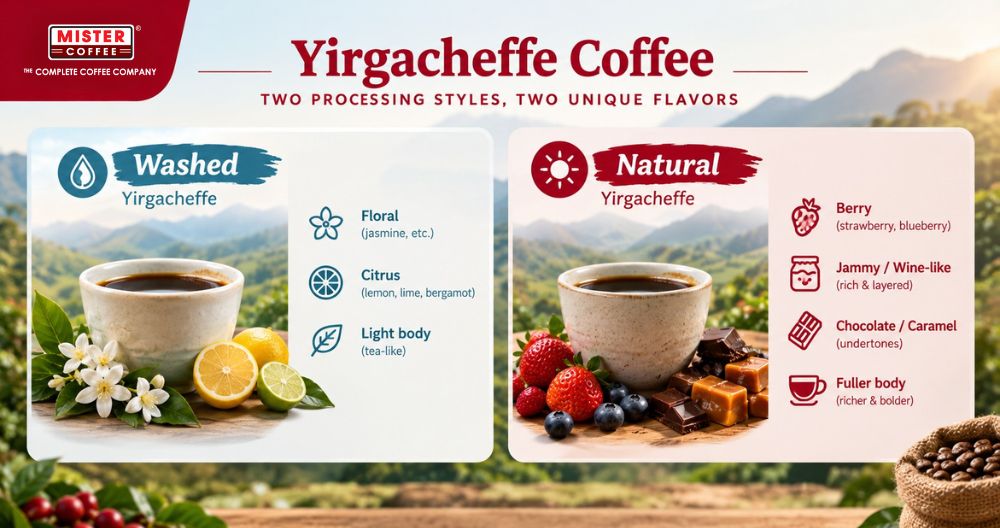
This is the question I get asked most, and the honest answer depends partly on the processing method.
Both share a family resemblance, but if you’ve only tried one style, trying the other is genuinely worth it. I still remember the first time I tasted a natural-processed Yirgacheffe side by side with a washed one from the same season; it was hard to believe they came from the same origin.
If you roast your own beans, resist the urge to push Yirgacheffe into a dark roast. Light to light-medium roasts preserve the delicate floral and citrus compounds that make this origin special, while darker roasts tend to mute or completely mask them under roast-driven bitterness.
Roasters generally aim to pull Yirgacheffe just past first crack, sometimes even before a full development period typical of darker roasts, specifically to protect those volatile aromatics. If you’re buying pre-roasted beans instead, look for a light or light-medium roast label on the bag as your starting point.
Learn more: Medium vs Dark Roast Coffee – The Ultimate Guide to Finding Your Perfect Cup
This is where most of the magic actually happens. A manual pour-over, specifically something like a Hario V60 or another flat-bottom dripper, is genuinely the best method for showing off this coffee’s floral and citrus character.
Essential Parameters
| Setting | Recommendation |
|---|---|
| Coffee dose | 15g to 20g |
| Water-to-coffee ratio | 1:16 (e.g., 240g water for 15g coffee) |
| Grind size | Medium-fine, similar to table salt |
| Water temperature | 90°C–93°C (194°F–200°F) |
| Total brew time | 2:30–3:00 minutes |
Step-by-Step Guide
My note: the bloom stage genuinely matters more with Yirgacheffe than with heavier, darker coffees. Rushing it or skipping it tends to flatten the floral aromatics that make this origin worth brewing carefully in the first place.
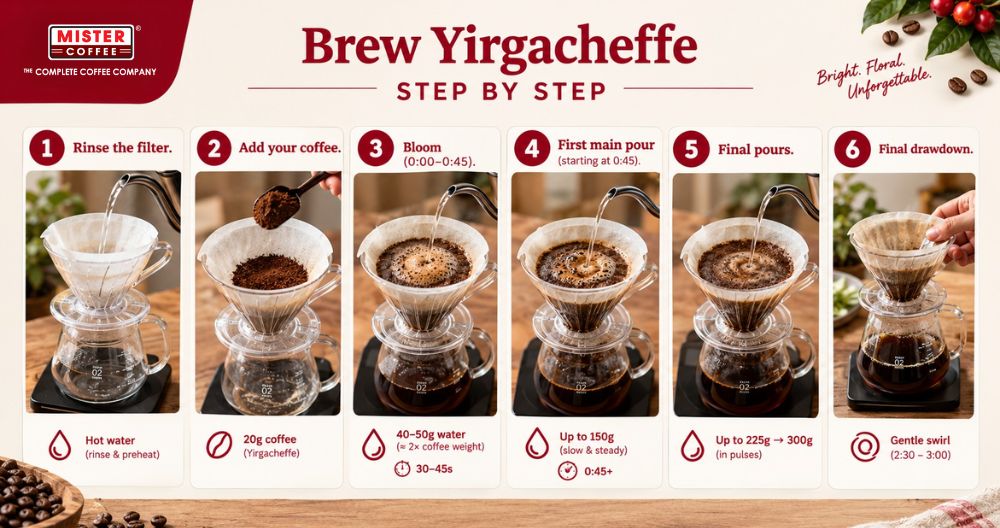
You don’t need an expensive setup to brew Yirgacheffe well, but a few specific tools genuinely help more here than with other coffees.
A gooseneck kettle gives you the control to pour slowly in tight, even circles, which matters a lot when you’re trying to protect delicate floral notes from uneven extraction. A standard wide-spout kettle makes it much harder to control your pour rate precisely.
A digital scale makes it easy to measure your ratio accurately. Since Yirgacheffe is sensitive to small changes in extraction, eyeballing your water volume is one of the easiest ways to end up with an inconsistent cup from one brew to the next.
A burr grinder, rather than a blade grinder, gives you a consistent particle size, which directly affects how evenly your coffee extracts. Blade grinders tend to produce a mix of fine dust and larger chunks, which pulls bitterness from the fine particles while under-extracting the larger ones, muddying exactly the clarity that makes washed Yirgacheffe special.
None of this needs to be expensive. Even an entry-level gooseneck kettle and a basic burr grinder will get you most of the way there.
Since the two processing styles behave differently in the cup, they also behave slightly differently in the brewer.
For washed Yirgacheffe, keep your agitation low and let the pour do the work gently. If the cup tastes sharp or astringent, try a slightly coarser grind to pull back extraction a touch.
For natural Yirgacheffe, drop your water temperature toward the lower end of the range, closer to 90°C, and consider grinding slightly coarser as well. Natural-processed beans are more soluble than washed ones, so over-extracting them tends to produce a muddy, over-fermented taste rather than the clean berry sweetness you’re after.
If your cup isn’t quite right, here’s how I’d adjust it:
Too sour or sharp: grind slightly finer, raise your water temperature a touch (up to around 94°C), or extend your extraction time slightly.
Too bitter or dry on the finish: grind slightly coarser, and lower your water temperature.
Want more floral, jasmine-like notes: stick with a light or light-medium roast, and avoid pushing your water temperature or extraction time too high, over-extraction is what buries those delicate aromatics first.
Small adjustments genuinely go a long way here. I’d rather you make one change at a time and taste the difference than adjust three variables at once and lose track of what actually helped.
While V60 is my default recommendation, it’s not the only option worth trying.
AeroPress produces a clean cup that highlights citrus and tea-like qualities nicely, and it’s a great option if you want something faster than a full pour-over routine.
Cold brew works particularly well with naturally processed Yirgacheffe, since the long, cold steep tends to emphasize the sweeter berry notes those lots are known for, without pulling forward too much acidity.
Learn more: Types of Coffee Brewing Techniques
A quick practical note for anyone brewing this in Malaysia specifically: our heat and humidity are not kind to delicate, aromatic coffees like Yirgacheffe. Store your beans in a sealed, airtight container, away from direct light and heat, and only grind what you need right before brewing.
Freshness matters more with this origin than almost any other I work with. Those floral top notes fade noticeably within a few weeks of the roast date, so buying smaller quantities more often will serve you better than stockpiling a large bag. I’d rather see you finish a smaller bag at its peak than work through a bigger one that’s lost half its character by the final cup.
Learn more: How to Define Freshly Roasted Coffee Bean?
A coffee grown in the Yirgacheffe area of Ethiopia’s Gedeo Zone, known for its floral, citrus, and tea-like character, largely thanks to high altitude, heirloom varietals, and shade-grown smallholder farming.
High altitude slows cherry maturation for better flavor development, heirloom genetic diversity creates distinctive profiles, and meticulous small-scale processing preserves those delicate qualities through to your cup.
Washed lots taste floral and citrusy with a tea-like body; natural lots taste more like berries, jam, and chocolate with a fuller body.
Look for specialty coffee retailers offering traceable, single-origin lots. Mister Coffee’s specialty range includes both washed and natural Yirgacheffe options with full traceability to their washing stations.
A V60 or similar pour-over, using a 1:16 ratio, medium-fine grind, and water between 90°C and 93°C, brings out its floral and citrus character best.
Light to light-medium roasts preserve the delicate aromatics; darker roasts tend to mute or mask them.
Yes, most Yirgacheffe coffee grows under the canopy of indigenous trees on small, traditional garden-style farms.
Brewing Yirgacheffe well isn’t complicated, but it does reward a little patience. Get your water temperature and grind size right, respect the bloom, and pour with a steady hand, and you’ll taste exactly why this origin has earned its reputation among specialty coffee drinkers worldwide.
If you’ve only ever had heavier, darker coffees before, a well-brewed Yirgacheffe genuinely might change how you think about what coffee can taste like. That first confusing, tea-like, jasmine-scented cup is usually the moment it clicks, and once it does, it’s hard to go back to thinking of coffee as just one flavor.


If you have ever wondered how to choose coffee beans without wasting money, you are in the right place. I still...
I still remember the first time I made a latte at home that actually tasted like something from a café,...
I’ve been in the coffee industry for years and if there’s one thing I never get tired of, it’s watching...
Which coffee brewing method is best? The honest answer is, it depends on you and your lifestyle. Coffee brewing isn’t...
If you are a coffee lover, you probably have seen drip bags around. But did you know that the single-serve...
Latte art is a beautiful thing. You can be an art critic and still drink your coffee at the same...