

Is decaf really that different from regular coffee? The biggest difference between decaf and regular coffee is caffeine. But taste, processing, and nutrition matter too. And no, decaf isn’t automatically weaker or less nutritious.
In this guide, I’ll compare both side by side, with real data and a few charts, so you can choose the right cup for you.
Table of Contents
Short answer: the main difference between decaf and regular coffee is caffeine. A regular cup has around 80 to 100 mg. Decaf usually has 2 to 15 mg. Beyond caffeine, the difference between decaf and regular coffee is small: calories, antioxidants, and minerals stay very similar.
| Feature | Regular coffee | Decaf coffee |
|---|---|---|
| Caffeine | Approximately 80–100 mg per 8 oz brewed cup | Typically 2–15 mg per 8 oz cup |
| Taste | Varies widely by bean and brewing method | Similar range, but processing can influence flavor. |
| Aroma | Depends on roasting and freshness | May differ slightly due to decaffeination |
| Calories | Very low when served black | Very low when served black |
| Antioxidants | Contains polyphenols and other beneficial compounds | Retains many of the same compounds |
| Processing | Roasted and brewed without caffeine extraction | Caffeine is mostly removed before roasting. |
| Best suited for | People wanting caffeine’s stimulating effects | People looking to reduce caffeine intake |
Caffeine figures are general estimates, not guaranteed values for individual products. Sources: U.S. FDA, Mayo Clinic.
So, what is the difference between regular coffee and decaf coffee at its core? It starts before the beans are even roasted.
Regular coffee contains caffeine naturally. Coffee plants produce it as a defense against insects.
Arabica beans typically contain about 1.2% to 1.5% caffeine, while Robusta contains roughly twice as much. The beans are roasted, ground, and brewed, and the caffeine comes along for the ride.
Caffeine blocks adenosine, a brain chemical that makes you feel sleepy. That’s why your morning cup helps you feel alert and focused. Caffeine is what makes the difference between decaf and regular coffee so noticeable in how you feel.
Decaf is regular coffee with most of the caffeine removed. This happens while the beans are still green, before roasting. That one processing step is the root of every other difference between decaf and regular coffee.
Common methods use water (such as the Swiss Water Process), pressurized carbon dioxide, or solvents such as methylene chloride or ethyl acetate. Our own decaf beans use the solvent-based European method and meet the European standard of no more than 0.1% caffeine.
Decaf isn’t completely caffeine-free, though. A small amount always remains. For the full story, read our guide on what decaf coffee is.
This is where the difference between decaf and regular coffee is biggest. Let’s look at the numbers.
According to the Mayo Clinic, an 8 oz (about 240 ml) cup of brewed coffee contains around 96 mg of caffeine. The same cup of brewed decaf contains about 1 mg. The U.S. FDA notes that decaf can contain 2 to 15 mg per 8 oz cup.
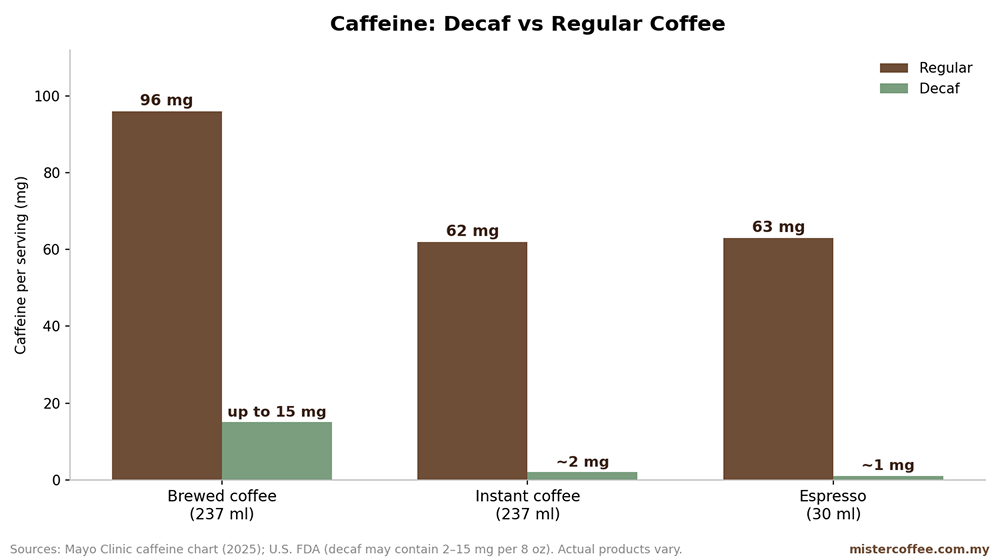
Decaf contains a small fraction of the caffeine in regular coffee across every format.
Why isn’t decaf zero? Decaffeination usually removes about 97% or more of the caffeine, not all of it.
Here’s a simple example. If a 10 g dose of regular Arabica holds about 120 mg of caffeine, removing 97% still leaves around 3.6 mg. That’s tiny, but it isn’t nothing. Under the European standard of no more than 0.1% caffeine, a 10 g dose of decaf contains at most 10 mg.
Caffeine levels vary in both decaf and regular coffee. The main factors are
That’s why the difference between decaf and regular coffee can look bigger or smaller depending on the cup in front of you.
The FDA says up to 400 mg of caffeine a day is generally not linked to negative effects in most healthy adults. That’s roughly four cups of regular brewed coffee.
But sensitivity varies a lot. Some people feel jittery after one cup. Others sleep fine after three.
Pregnant women, people with certain heart or anxiety conditions, and those taking some medications may need lower limits. In these cases, please follow your doctor’s advice. Knowing your limit helps you decide how much the difference between decaf and regular coffee matters for you. For more detail, see our guide to caffeine in coffee.
When it comes to the difference between decaf and regular coffee, taste is what coffee lovers care about most. Is there a real taste difference between decaf and caffeinated coffee?
Caffeine is naturally bitter. So removing it takes away a little of the bitterness, but only a little. Most of coffee’s bitterness comes from compounds formed during roasting.
Decaffeination can also soften some aroma and body. That’s why some decaf tastes slightly milder or smoother.
But here’s what surprised me. When I tasted our ESTE decaf blend next to a regular espresso blend, both brewed the same way, the difference between decaf and regular coffee was smaller than I expected. ESTE still had a full body and a gentle bitterness. A friend tasting with me guessed wrong.
So the decaf vs. regular coffee taste debate isn’t about weak versus strong. It’s about how well each coffee is grown, processed, and roasted.
Not necessarily. There are two kinds of “acidity” to think about.
Perceived acidity is the bright, lively taste, like citrus or berries. Measured pH is the actual chemical acidity. Most brewed coffee sits roughly between pH 4.8 and 5.2.
Decaf is not automatically low-acid coffee. Origin, roast level, and processing matter far more. Our Decaffeinated Arabica ALBA, for example, is rated four out of five for acidity, with fruity and citrusy notes. Darker roasts and Robusta-rich blends usually taste less acidic, whether decaf or not. So acidity isn’t a reliable difference between decaf and regular coffee.
Five things shape how your decaf tastes:
Our three decaf beans show how varied decaf can be. ALBA is fruity and citrusy. ESTE is balanced and smooth. RIVA is bold and strong. That range proves the difference between decaf and regular coffee isn’t about flavor being “missing.”
Nutrition is where people often assume the difference between decaf and regular coffee is big. The data says otherwise.
Plain black coffee is almost calorie-free, whether decaf or regular. USDA data lists about 2 kcal in a cup of regular brewed coffee and 0 kcal in brewed decaf, with no sugar or carbohydrates in either.
Removing caffeine doesn’t make coffee lower in calories or sugar by itself. Your additions do. In calorie terms, the difference between decaf and regular coffee is practically zero.
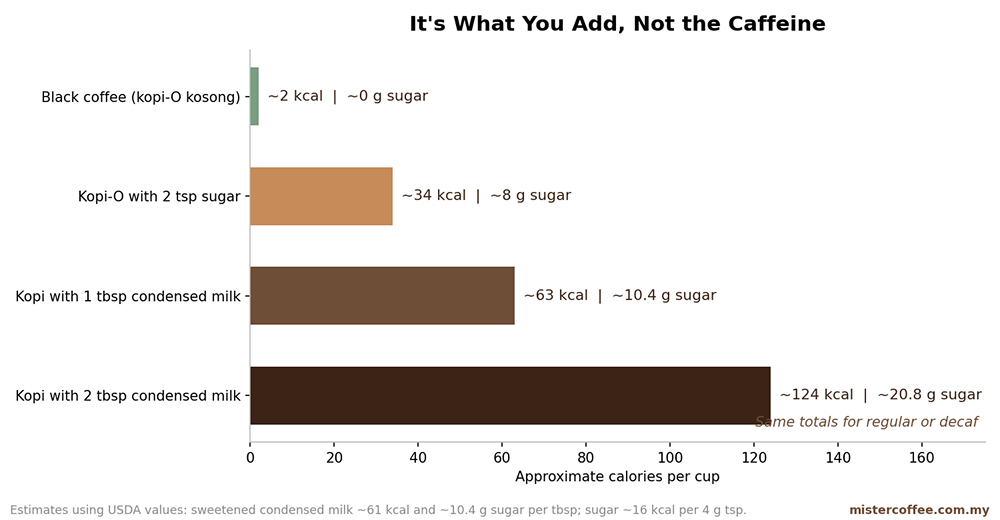
Difference between decaf and regular coffee calories with condensed milk and sugar
Estimates using USDA values. These totals are the same for regular or decaf.
One tablespoon of sweetened condensed milk adds about 61 kcal and 10 g of sugar. A typical kopi with two tablespoons can reach around 125 kcal. Switching to decaf won’t change that. Taking it kosong, or with less condensed milk, will.
Coffee is rich in polyphenols, especially chlorogenic acids. These antioxidants help neutralize free radicals linked to cell damage.
Decaffeination can change chlorogenic acid levels slightly, but roasting has a much bigger effect. Darker roasts generally contain less of these compounds than lighter ones, in both decaf and regular coffee.
So when it comes to antioxidants, the difference between decaf and regular coffee is small. Both can be a useful source in your diet.
Coffee contains small amounts of potassium, magnesium, and B vitamins such as niacin.
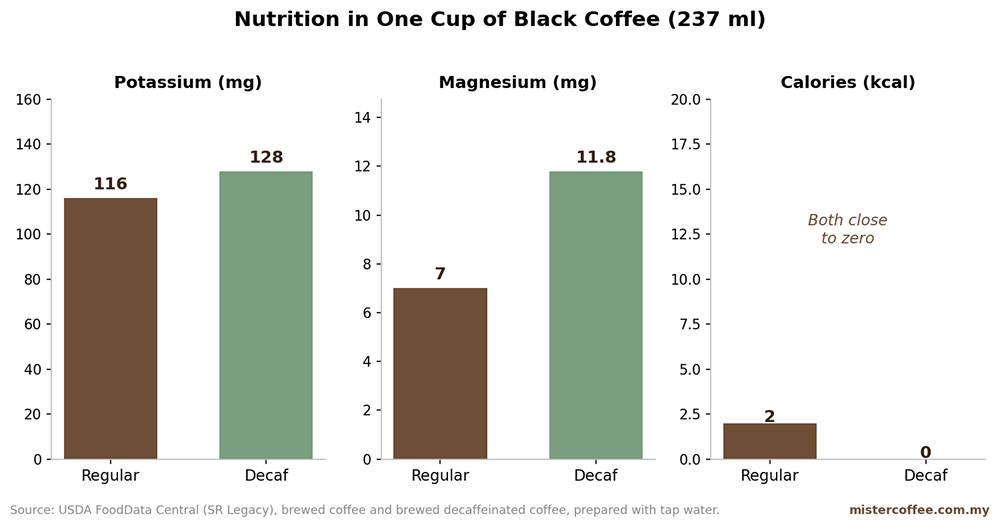
Per 237 ml cup of black brewed coffee, the nutrition data is as follows: Source: USDA FoodData Central.
| Per 237 ml cup, black | Regular brewed | Decaf brewed |
|---|---|---|
| Calories | 2 kcal | 0 kcal |
| Protein | 0.28 g | 0.24 g |
| Carbohydrates and sugar | 0 g | 0 g |
| Potassium | 116 mg | 128 mg |
| Magnesium | 7 mg | 11.8 mg |
| Caffeine | About 96 mg | About 1–15 mg |
Nutrient values from USDA FoodData Central (SR Legacy). Caffeine values are from the Mayo Clinic and the FDA.
Interestingly, USDA data shows a small mineral difference between decaf and regular coffee, with slightly more potassium and magnesium in decaf. But the amounts are tiny either way, about 3% of daily needs. Coffee shouldn’t be treated as a major source of essential nutrients. Fruits, vegetables, and whole grains do that job much better.
Large studies link coffee drinking, both decaf and regular, with lower risks of type 2 diabetes, heart disease, and early death.
For example, a 2014 analysis of 28 studies found each extra daily cup was linked to a 9% lower diabetes risk for regular coffee and 6% for decaf. A 2022 UK Biobank study also linked two to three cups of decaf a day with lower cardiovascular and overall mortality risk.
Remember, these are associations, not proof that coffee causes the benefits. And many likely come from antioxidants and other compounds, not caffeine. So the health difference between decaf and regular coffee seems smaller than many people think.
Regular coffee’s biggest strength is caffeine. It improves alertness and concentration. Sports science reviews also link moderate caffeine doses, around 3 to 6 mg per kg of body weight, with better endurance performance. Our guide to coffee before a workout explains more.
The drawbacks also come from caffeine consumption. Sensitive people may get jitters, palpitations, anxiety, or trouble sleeping. Caffeine has an average half-life of around five hours, so an afternoon cup can still be active at bedtime. For sensitive people, the caffeine content is the most important difference between decaf and regular coffee.
People choose decaf for practical reasons:
My own reason is simple. I love an evening cup, but I also love sleeping. For me, that’s the real difference between decaf and regular coffee. For the full health picture, read our guide to decaf coffee benefits.
Once you understand the difference between decaf and regular coffee, choosing decaf or regular coffee comes down to your body, your routine, and your taste.
| Your preference or situation | What to consider |
|---|---|
| Need an energy boost in the morning | Regular coffee provides more caffeine. |
| Want coffee in the evening | Decaf may be preferable, although it still contains caffeine. |
| Sensitive to caffeine | Decaf can help reduce exposure. |
| Enjoy strong, bold coffee flavors. | Either type can work; consider the bean and roast |
| Want to reduce caffeine gradually | Try a mix of regular and decaf. |
| Pregnant or managing a medical condition | Consider individual medical guidance and total caffeine intake. |
| Drink coffee mainly for taste. | Choose based on flavor profile rather than caffeine alone. |
The decaf vs. caf coffee choice doesn’t have to be all or nothing. Many people drink both.
Yes. It’s called half-caff, and it splits the difference between decaf and regular coffee nicely.
The simplest version is a 50:50 mix of regular and decaf grounds. You can also go 75:25 or 25:75, depending on how much caffeine you want.
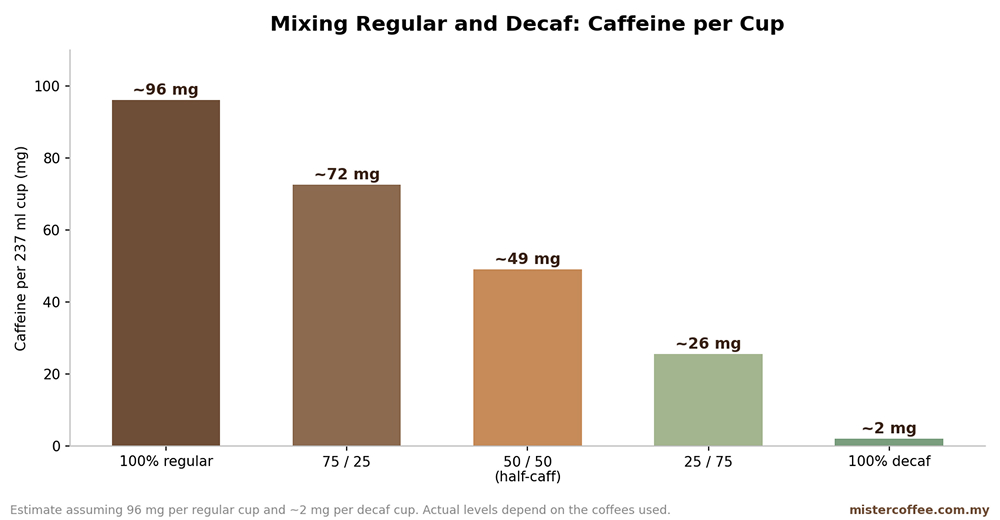
Estimates assume 96 mg for a regular cup and about 2 mg for decaf.
When I wanted to cut back, I started with 75:25 for a week, then moved to 50:50. My afternoon slump eased, and I barely noticed the change in taste. Just remember: the actual caffeine reduction depends on the coffees you use.
Ready to taste the difference between decaf and regular coffee for yourself? Here’s how to choose.
| Mister Coffee product | Taste profile | Suggested audience |
|---|---|---|
| Decaffeinated Arabica ALBA (200g) | Fruity and citrusy, lower bitterness | Coffee drinkers who enjoy brighter flavors |
| Decaffeinated ESTE Blend (200g) | Balanced, smooth, and full-bodied | Everyday coffee drinkers |
| Decaffeinated Robusta RIVA (200 g) | Bold, strong, and full-bodied | Fans of stronger coffee flavors |
Product descriptions are based on Mister Coffee’s published specifications.
Explore Mister Coffee’s decaf range and choose the format that suits your routine.
Yes, a little. Decaffeination removes about 97% or more of the caffeine, but not all. Mayo Clinic lists about 1 mg in an 8 oz cup of brewed decaf, while the FDA says decaf can contain 2 to 15 mg. Regular brewed coffee has around 96 mg.
Very close, but not always identical. Most of the taste difference between decaf and regular coffee comes from processing. Decaffeination can soften some aroma and body, and removing caffeine slightly reduces bitterness. Bean quality, roast, and freshness matter much more. A well-roasted, fresh decaf can taste rich and satisfying.
Mostly, yes. USDA data shows both are almost calorie-free, with similar small amounts of potassium and magnesium. Decaf keeps most of coffee’s antioxidants, though levels vary with roast and processing. The nutritional difference between decaf and regular coffee is small.
Usually, yes. For sleep, caffeine is the key difference between decaf and regular coffee. It stays in your body for hours, with an average half-life of around five hours. Decaf’s tiny caffeine content is far less likely to affect sleep. Very sensitive people may still want to avoid any coffee close to bedtime.
Not automatically. Most brewed coffee falls between about pH 4.8 and 5.2, and decaf is in a similar range. Perceived acidity depends more on origin, roast, and processing. Dark roasts and Robusta blends usually taste less acidic, decaf or not.
Yes. For most healthy adults, a few cups of decaf a day is fine. Large studies even linked two to three daily cups with health benefits. Watch the sugar and creamer, and count decaf’s small caffeine if you’re pregnant or very sensitive.
Neither is better for everyone. The key difference between decaf and regular coffee is caffeine, so regular coffee suits people who want an alertness boost. Decaf suits people who are sensitive to caffeine, drink coffee late, or want to cut back. The best choice depends on your body, routine, and taste.
Not necessarily. Moderate caffeine is safe for most healthy adults, and up to 400 mg a day is the FDA’s general reference. But if caffeine disrupts your sleep, raises your anxiety, or worsens a health condition, cutting back may help you feel better.
It can be. Decaf keeps most of coffee’s antioxidants and is linked with lower risks of type 2 diabetes and heart disease in large studies. These are associations, not proof. Keep it simple, with little sugar, for the most benefit.
Let’s recap the difference between decaf and regular coffee in three parts.
Caffeine: Regular coffee has around 80 to 100 mg per cup. Decaf usually has 2 to 15 mg. This is the biggest difference by far.
Taste: Decaf can taste slightly milder, but good beans and fresh roasting close most of the gap.
Nutrition: Calories, minerals, and antioxidants are very similar. What you add matters more than the caffeine.
So in the decaf versus regular coffee debate, neither wins outright. Choose based on your caffeine tolerance, your taste, and your daily habits.
If you’re curious, start with an evening cup of decaf and see how you feel. Try both side by side, and you’ll taste the difference between decaf and regular coffee for yourself. Our decaf coffee range has beans, drip bags, pods, capsules, and instant sticks to make it easy.
Happy brewing.


For years, my 4 pm kopi came with a price. I'd lie awake at midnight, staring at the ceiling, wondering...
"Both say Colombia. So why is one RM60 for 500 g, and the other RM75 for just 250 g?" A customer...
My sister has exactly one coffee ritual: rip open a sachet, pour hot water, stir, done. No grinder, no scale,...
I still remember a regular at our café counter holding up two cups, sniffing each one, and asking me, half-joking,...
I still remember the first time someone handed me a cup of coffee and said, "you'll get notes of blueberry...
If you're anything like me, a proper brew is an essential part of your morning routine. Over the years, I’ve...