

For years, my 4 pm kopi came with a price. I’d lie awake at midnight, staring at the ceiling, wondering why I was so tired yet so wide awake.
Then I switched my afternoon cup to decaf. Same ritual, same aroma, far better sleep. That small change made me curious about decaf coffee benefits beyond a good night’s rest.
So I dug into the research. Here’s what science says about decaf coffee benefits and side effects, from your heart and liver to reflux and pregnancy, explained simply, with real numbers and a few charts.
Quick note: this article is for general information, not medical advice. If you have a health condition, are pregnant, or take medication, please check with your doctor.
Table of Contents
“Decaf” is short for decaffeinated coffee. It’s regular coffee with most of the caffeine removed before roasting.

Typically, at least 97% of the caffeine is removed. Everything else, including the aroma compounds, antioxidants, and minerals, mostly stays. That’s why decaf coffee benefits overlap so much with those of regular coffee.
Yes, a little. Decaf is low-caffeine, not zero-caffeine.
So, how much caffeine is in decaf coffee? Mayo Clinic lists about 1 mg in an 8 oz (237 ml) cup of brewed decaf. The U.S. FDA says decaf can contain 2 to 15 mg per 8 oz cup. A regular brewed cup has around 96 mg.
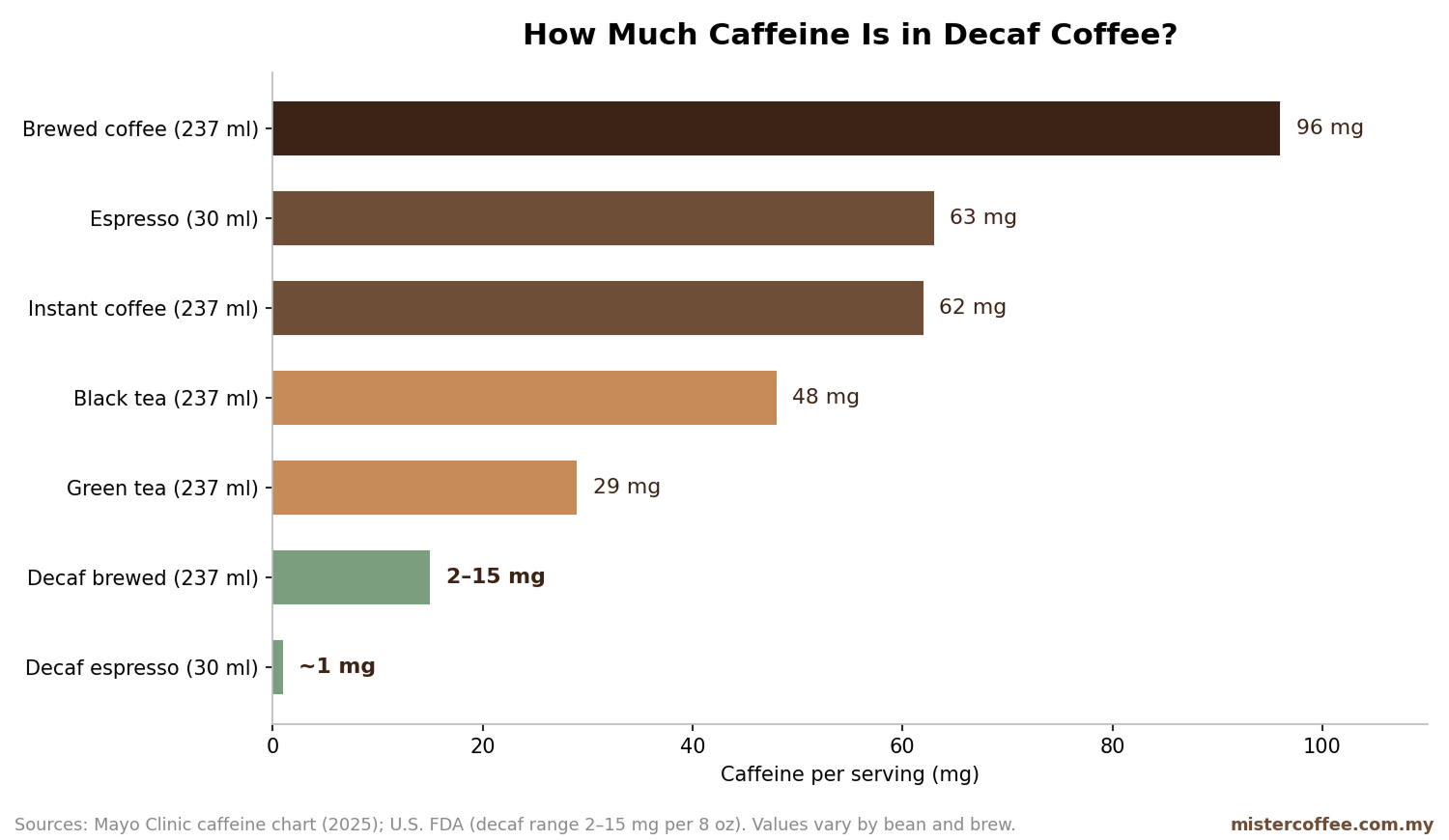
Decaf contains a tiny fraction of the caffeine in regular coffee. Sources: Mayo Clinic, U.S. FDA.
Here’s a simple way to picture it. Our decaf beans follow the European standard of no more than 0.1% caffeine. So a 10 g dose of ground decaf contains at most 10 mg of caffeine, and usually less ends up in your cup. Regular coffee beans typically contain more than ten times that.
Want the full background? Read our guide on what decaf coffee is and our explainer on caffeine in coffee.
All decaf starts as green, unroasted beans. Understanding the process helps you weigh decaf coffee benefits against any risks. The caffeine is removed first, then the beans are dried and roasted like any other coffee.
There are four main decaffeination methods:
| Method | How it works | Good to know |
|---|---|---|
| Methylene chloride (“European method”) | Beans are steamed or soaked, then a solvent binds to the caffeine and is removed. | Efficient and flavor-friendly. Strict residue limits apply. |
| Ethyl acetate (“sugarcane process”) | A solvent found naturally in fruit and sugarcane removes the caffeine. | Often marketed as “natural” decaf |
| Swiss Water Process | Water and carbon filters remove caffeine without added solvents. | Solvent-free, usually more expensive |
| CO₂ method | Pressurized carbon dioxide pulls caffeine from the beans. | Solvent-free, common at large scale |
Swiss Water Process decaf coffee has become popular with people who want a solvent-free option. It’s a good choice if that matters to you.
Let me be transparent about our own beans. Our standard decaf coffee beans are processed in Europe using methylene chloride, meeting the European standard of no more than 0.1% caffeine.
Methylene chloride gets a lot of attention online, so here are the facts. It evaporates at around 40°C, and coffee is roasted at well over 200°C. The European Union limits residues to 2 mg per kg of roasted coffee. In the U.S., the FDA allows up to 10 parts per million.
As of mid-2026, the U.S. FDA is still reviewing a petition to remove methylene chloride from its food-additive rules, and no final decision has been announced. If you’d simply prefer to avoid solvents, look for Swiss Water or CO₂ decaf. Either way, the core decaf coffee benefits come from the coffee itself, not the method.
Here’s the big idea behind most decaf coffee benefits. Coffee isn’t just caffeine.
A cup of coffee contains hundreds of compounds, including polyphenols, chlorogenic acids, magnesium, and niacin. Decaffeination removes the caffeine but leaves most of these behind.
Let’s look at the main benefits of decaf coffee one by one. One honest caveat before we start. Most coffee research is observational. It shows links, not proof that coffee caused the benefit. Still, the patterns are consistent and encouraging.
Coffee is one of the biggest sources of antioxidants in many people’s diets, and decaf is no exception.
The main players are chlorogenic acids. They help neutralize free radicals, the unstable molecules linked to cell damage and inflammation. Decaffeination may remove a small share of them, but decaf still delivers plenty.
These decaf coffee antioxidant benefits may be behind many of the links you’ll read below. In short, antioxidants are the foundation of most decaf coffee benefits.
This is one of the best-studied decaf coffee benefits.
A major 2014 meta-analysis in Diabetes Care pooled 28 studies with more than 1.1 million people. Each extra daily cup of regular coffee was linked to a 9% lower risk of type 2 diabetes. Each extra cup of decaf was linked to a 6% lower risk.
Researchers here in Malaysia have looked at this too. A 2021 review led by scientists at Universiti Sultan Zainal Abidin in Terengganu analyzed controlled trials. In the included trials, decaf rich in chlorogenic acid lowered fasting blood sugar by about 4% to 5% over more than four weeks. The trials were small, and the results varied, so more research is needed.
Still, it’s a good sign that decaf coffee benefits for blood sugar seem to come from compounds other than caffeine.
The evidence looks promising.
A large UK Biobank study followed nearly 495,000 people for about 11 years. Coffee drinkers had a 21% lower risk of chronic liver disease and a 49% lower risk of dying from it, compared with non-drinkers. Importantly, the links held for decaf, ground, and instant coffee.
So, is decaf coffee good for the liver? It appears to share many of the same liver-friendly associations as regular coffee, which makes liver health one of the more encouraging decaf coffee benefits. It’s not a replacement for cutting alcohol or managing weight, though.
Another UK Biobank study, published in 2022 in the European Journal of Preventive Cardiology, looked at different coffee types.
Compared with non-drinkers, people drinking two to three cups of decaf a day had a 6% lower risk of cardiovascular disease and a 14% lower risk of death from any cause. These are some of the most widely cited decaf coffee benefits.
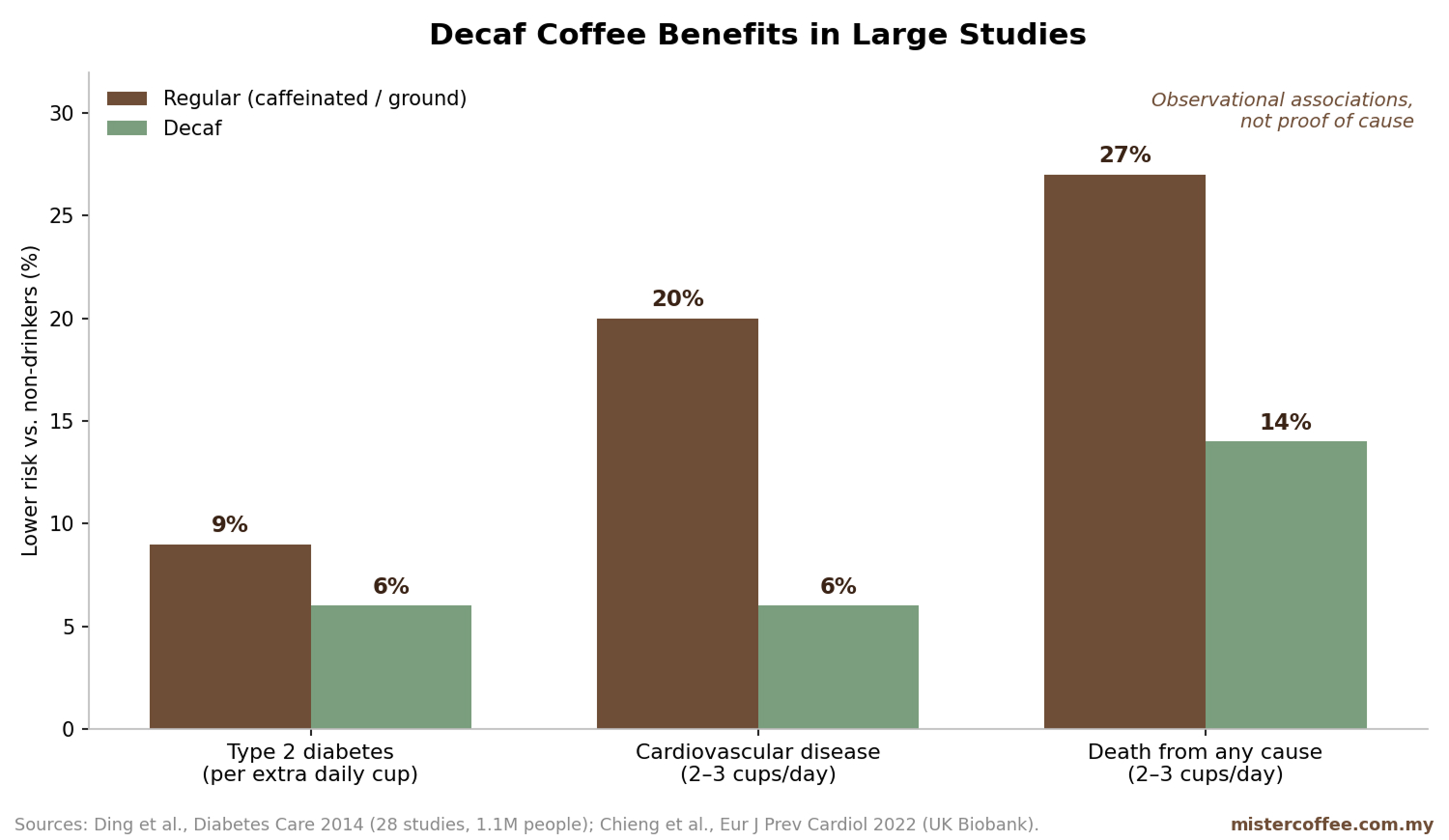
Regular coffee shows stronger links, but decaf still holds its own. Sources: Ding et al. 2014; Chieng et al. 2022 (ESC).
One interesting detail: in the same study, regular coffee was linked to fewer heart rhythm problems (arrhythmias), but decaf wasn’t. So decaf coffee and heart health are positive stories, just not identical ones.
Here the picture is less clear.
Some research links regular coffee with better memory and focus. But a U.S. study of adults over 60 found that link for caffeinated coffee, not for decaf. Caffeine itself may be doing some of the work.
Animal studies hint that decaf may still support mood and gut health, but human evidence is limited. So brain health is one of the less certain decaf coffee benefits. Our article on coffee and dementia explores this further.
Caffeine can raise blood pressure for a few hours, especially in people who don’t drink it often. A 2011 meta-analysis found that 200 to 300 mg of caffeine raised systolic blood pressure by about 8 mmHg for up to three hours.
Decaf avoids most of that spike. The Malaysian review mentioned above also found that decaf rich in chlorogenic acid lowered blood pressure slightly in some trials.
If you’re managing high blood pressure, decaf coffee and blood pressure make a friendlier pair. For many people, this is one of the most practical decaf coffee benefits. Just keep taking your medication and following your doctor’s advice.
Now back to my 4 pm kopi problem.
Caffeine has an average half-life of about five hours. That means half of it is still in your body five hours later. A classic 2013 sleep study found that 400 mg of caffeine taken even six hours before bed cut total sleep by more than an hour.
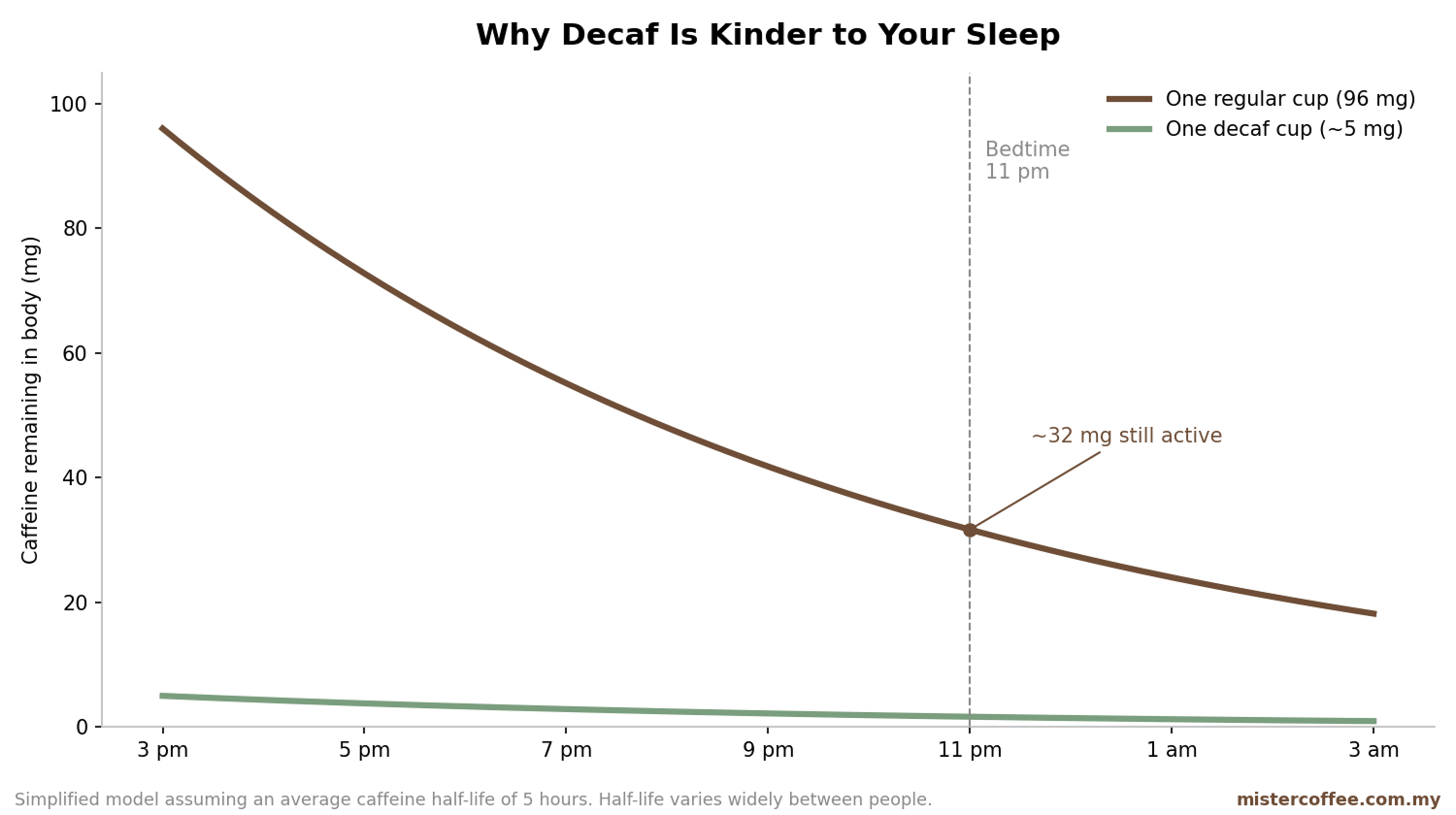
A regular cup at 3 pm can leave around a third of its caffeine active at bedtime. Simplified model.
That’s one of the clearest decaf coffee benefits. When it comes to decaf coffee and sleep, you keep the ritual without the late-night buzz.
My colleagues see this during Ramadan too. Many switch to decaf at iftar so they can sleep before sahur. Our guide to coffee during Ramadan shares more tips.
Decaf also helps if caffeine makes you jittery or anxious. Fewer racing thoughts, no shaky hands.
One surprise: a 2018 study found that decaf still made people feel a bit more alert than a placebo. Part of coffee’s lift may come from the ritual itself. I find that oddly comforting.
This is where decaf coffee benefits come with a few honest “buts.”
Caffeine can relax the muscle at the bottom of your esophagus, making it easier for acid to rise. A small 1997 study of people with reflux found that decaffeinated coffee caused less reflux than regular coffee.
However, decaf is still slightly acidic, and some people react to coffee whether it has caffeine or not. So decaf coffee and acid reflux can be a better match, but it’s not guaranteed.
My uncle has had heartburn for years. Switching to decaf helped him, but only when he stopped drinking it on an empty stomach as well.
Coffee doesn’t cause stomach ulcers. Most are caused by H. pylori bacteria or long-term use of painkillers like NSAIDs.
But coffee may irritate an existing ulcer. A classic 1975 study in the New England Journal of Medicine found that decaf still stimulated stomach acid, much like regular coffee. So if you have an active ulcer, ask your doctor before drinking any coffee, decaf included.
Coffee gets things moving, and that’s not just caffeine. A 1990 study in the journal Gut found that regular coffee stimulated the colon only about 23% more than decaf.
So decaf coffee and digestion still go together. If you rely on your morning cup for regularity, decaf may still help, just a little more gently. That’s one of the decaf coffee benefits people rarely talk about.
This is one of the most common questions I get.
Major health bodies, including the American College of Obstetricians and Gynecologists (ACOG) and the UK’s NHS, advise pregnant women to keep caffeine under 200 mg a day. Caffeine also stays in the body much longer during pregnancy.
So, can pregnant women drink decaf coffee? For most, this is one of the most valuable decaf coffee benefits: a practical way to enjoy coffee while staying well under that limit.
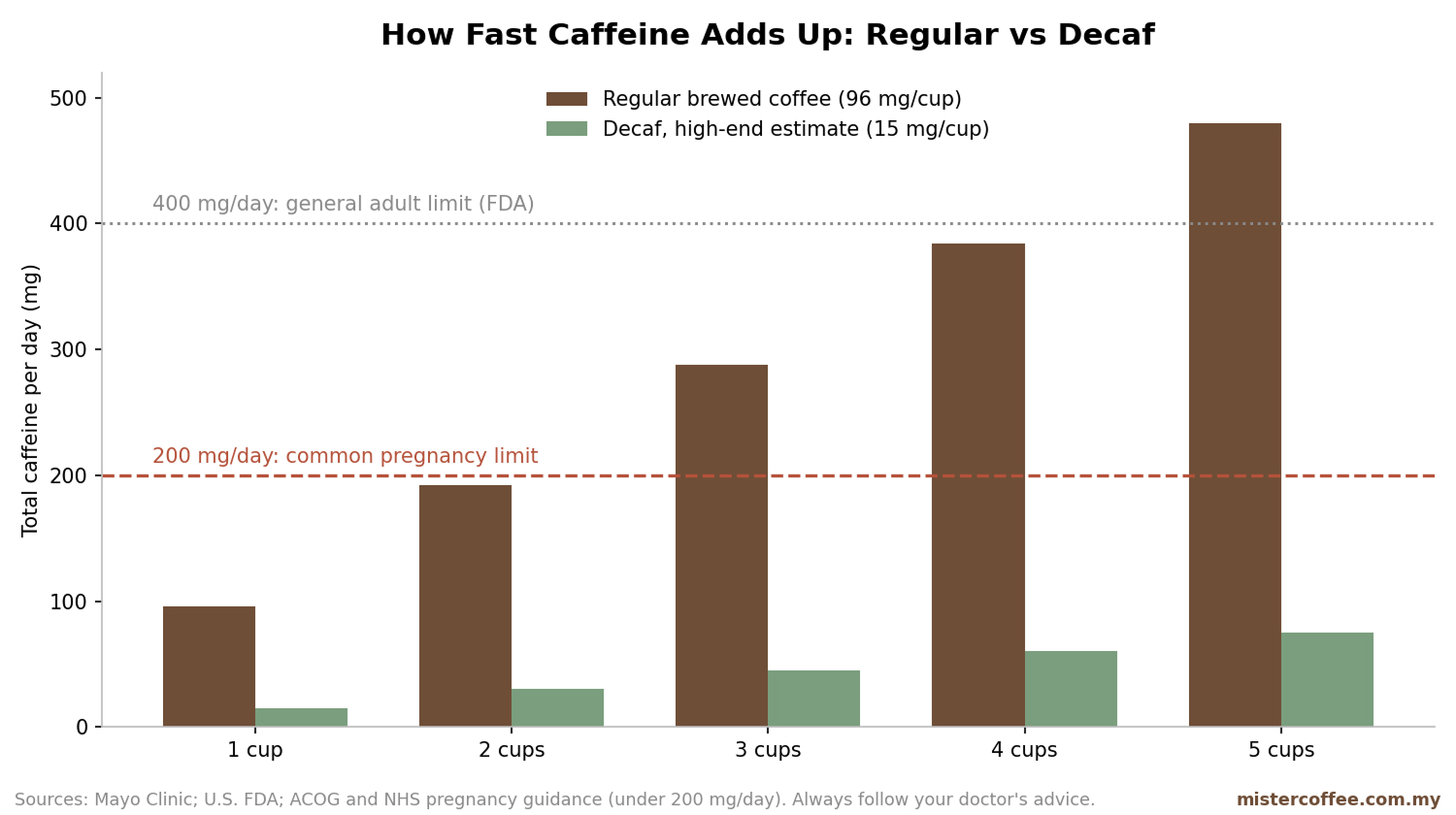
Even five cups of decaf at the high-end estimate stays far below 200 mg.
When a friend was expecting, she asked me whether she had to give up coffee completely. I told her two things. First, check with her doctor. Second, count caffeine from everything, including tea, chocolate, and soft drinks.
If you’d rather avoid solvents during decaf coffee during pregnancy, choose Swiss Water or CO₂ decaf.
Here’s one of the quieter decaf coffee benefits: black decaf has almost no calories, roughly 2 to 5 kcal per cup. That makes it a great swap for sugary drinks.
But decaf won’t melt fat on its own. The real issue is what you add. A cup with condensed milk and sugar can easily pass 100 kcal. Kopi-style decaf is still a treat, not a diet drink.
So, is decaf coffee good for weight loss? Only as part of a lighter routine. Keep it black, or add a splash of fresh milk.
No. Even regular coffee doesn’t dehydrate you in normal amounts. A 2014 study found that four cups of regular coffee a day hydrated men about as well as water. Decaf, with almost no caffeine, counts toward your daily fluids too. It’s a small but handy addition to the list of decaf coffee benefits.
To be fair, decaf coffee benefits come with some drawbacks. Here are the main disadvantages of decaf coffee.
It isn’t caffeine-free. If you’re extremely sensitive or your doctor asked you to avoid caffeine completely, even 2 to 15 mg can matter.
Solvent concerns. Some decaf uses chemical solvents. Residues are tightly limited, but if you want zero exposure, choose Swiss Water or CO₂ decaf.
You lose caffeine’s perks. Caffeine boosts alertness and exercise performance. Decaf won’t give you that pre-workout lift. Read our guide to coffee before a workout if that’s your goal. Some research on brain health and arrhythmia also shows weaker links for decaf.
It can still upset your stomach. As we saw, decaf still stimulates stomach acid.
Cholesterol questions. A small 1990s trial found LDL cholesterol rose slightly in men who switched to decaf, possibly because decaf was often made from Robusta beans then. Later research hasn’t consistently confirmed this, but it’s worth knowing.
What you add matters most. Sugar, sweetened creamer, and syrups can cancel out many decaf coffee benefits.
So, is decaf coffee bad for you? For most healthy adults, no. These decaf coffee side effects are mostly minor and easy to manage, and the decaf coffee benefits usually outweigh them.
Here’s a quick look at the difference between decaf and regular coffee.
| Regular coffee | Decaf coffee | |
|---|---|---|
| Caffeine (8 oz brewed) | About 96 mg | About 1–15 mg |
| Antioxidants | High | High, slightly lower |
| Alertness boost | Strong | Mild (mostly the ritual) |
| Sleep impact | Can disrupt sleep | Minimal |
| Blood pressure | Short-term rise possible | Little effect |
| Diabetes risk link | 9% lower per daily cup | 6% lower per daily cup |
| Stomach acid | Stimulates | Still stimulates |
| Best for | Mornings, focus, workouts | Evenings, sensitivity, pregnancy |
So, is decaf coffee healthy? For most people, yes. But is decaf coffee healthier than regular coffee? Not automatically. For many healthy adults, moderate regular coffee shows slightly stronger health links.
But decaf is the healthier choice if caffeine affects your sleep, heart rate, anxiety, reflux, or pregnancy. In decaf coffee vs. regular coffee, the best choice depends on your body, not on a rule. If caffeine bothers you, the decaf coffee benefits clearly win.
Personally, I drink both. Regular before lunch, decaf after 2 pm. It’s the best of both worlds.
Decaf coffee benefits aren’t the same for everyone. In my experience, these people gain the most:
If you’re a healthy adult who sleeps well on regular coffee, you don’t have to switch. But an evening decaf can still be a lovely habit.
There’s no official limit for decaf, because the caffeine is so low.
In the UK Biobank heart study, the lowest risks were seen at two to three cups of decaf a day. That’s also where decaf coffee benefits showed up most clearly in that research. For most healthy adults, two to four cups a day is a sensible range.
So, is decaf coffee safe to drink every day? Yes, for most people. Just watch the sugar, and remember that caffeine from decaf can add up if you’re pregnant or very sensitive.
A few simple habits make a big difference:
These small steps protect the decaf coffee benefits you’re drinking it for in the first place.
Honestly? Good decaf tastes like good coffee.
The taste of decaf coffee can be slightly milder because decaffeination removes a little of the body and aroma. But fresh, well-roasted decaf is far better than most people expect.
I once ran a blind tasting in our office. Two cups, one regular and one decaf, both medium-dark roasts. Almost half my colleagues guessed wrong.
So, does decaf coffee taste good? If it’s fresh and well roasted, absolutely. After all, decaf coffee benefits only matter if you enjoy drinking it. Freshness matters even more with decaf, so look for good packaging. Our guide to freshly roasted coffee beans explains why.
Looking for decaf coffee in Malaysia? Here’s our decaf range, all sealed with Modified Atmosphere Packaging (MAP) to protect freshness.
| Product | Format | Taste notes | Best for |
|---|---|---|---|
| Decaffeinated Arabica ALBA (200g) | Beans or ground | Fruity and citrusy, low bitterness | Pour-over, black coffee lovers |
| Decaffeinated ESTE Blend (200g) | Beans or ground | Balanced and smooth, full body | Everyday drinking, with milk |
| Decaffeinated Robusta RIVA (200 g) | Beans or ground | Bold Robusta character | Strong, kopi-style cups |
| DripBrew Decaf | Drip bags | Easy and convenient | Office and travel |
| Decaf Instant Soluble Black Coffee | 30 sticks × 2 g | Quick black coffee | Busy days |
| N Cap Decaf (10 pcs) | Nespresso-compatible capsules | Decaf espresso with crema | Capsule machines |
| EseBrew Decaffeinated (10 sachets) | E.S.E. espresso pods | Espresso-style decaf | E.S.E. pod machines |
| PodBrew Decaffeinated (10 sachets) | Soft pods | Clean, simple cup | Soft-pod brewers |
New to drip bags? Here’s our DripBrew brewing guide. Using capsules or pods? See our guides to N-Cap capsules and the EseBrew pod machine.
You can buy online or check our store locator for selected retail outlets. Ranges vary by store, so check before you go.
So, what are the health benefits and drawbacks of decaf coffee?
The decaf coffee benefits are real. Decaf keeps most of coffee’s antioxidants. It’s linked to lower risks of type 2 diabetes, liver disease, heart disease, and early death. And it’s far kinder to your sleep, blood pressure, and nerves.
The drawbacks are mostly small. Decaf still has a little caffeine, can still upset a sensitive stomach, and won’t give you the caffeine boost. If solvents worry you, choose Swiss Water or CO₂ decaf.
For me, decaf coffee benefits come down to one simple thing. I still get my afternoon coffee, and I still get my sleep.
Happy brewing.
The main decaf coffee benefits come from its antioxidants. In large studies, decaf is linked to lower risks of type 2 diabetes, liver disease, and heart disease. It also causes far less sleep disruption, jitteriness, and blood pressure spikes than regular coffee.
Usually about 1 to 15 mg per 8 oz cup, compared with around 96 mg in regular brewed coffee.
For most healthy adults, no. The main downsides are trace caffeine, possible solvent residues within legal limits, and stomach irritation in some people.
Generally, yes. Decaf helps keep caffeine well under the commonly advised 200 mg a day. Always confirm with your doctor.
It may cause less reflux than regular coffee, but decaf is still acidic. If symptoms continue, speak with your doctor.
For most healthy adults, two to four cups a day is a sensible range. Large studies saw the lowest heart risks at two to three cups.


If you are a Muslim person, the answer is yes, you can absolutely drink coffee during Ramadan. There’s nothing in...
Coffee is one of the most widely enjoyed drinks in the world, valued not just for its flavor but also...
Recent studies from Ningxia Medical University of China have shown that consuming coffee might do more...
Caffeine in coffee is the natural stimulant that gives your morning brew its signature boost, helping you feel more alert,...