

You’re in Ipoh’s Old Town, and everyone around you is ordering white coffee. You expect something pale, maybe brewed from special white beans. What arrives is a caramel-brown cup, sweet and creamy.
That’s the first thing to know about kopi putih: it isn’t white at all.
Here’s the short answer. Ipoh white coffee is made from beans roasted with margarine and no sugar, then served with sweetened condensed milk. Regular kopi beans are roasted darker, with sugar added in the roaster.
Below, you’ll find what goes into a cup, how it differs from kopi, whether it’s really stronger, and how to choose a good instant white coffee.
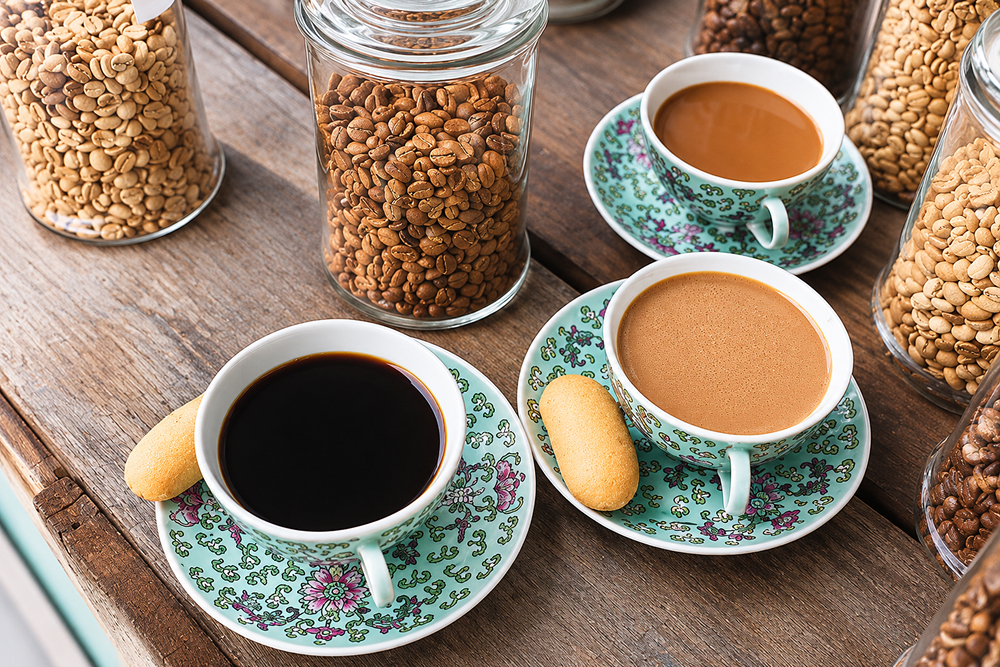
Table of Contents
In Malaysia, white coffee (kopi putih in Malay) usually means the Ipoh style. The beans are roasted with margarine but without sugar, giving a lighter roast than traditional kopi. The brewed coffee is then mixed with sweetened condensed milk and served hot or iced.
A traditional cup has just three parts:
As the Ipoh entry on Wikipedia explains, the beans are roasted with palm oil margarine and no sugar, while traditional kopi O beans are roasted with sugar, margarine, and wheat. So the sweetness comes from the milk, not the roast.
The name is a literal translation of its Chinese name, 怡保白咖啡. The beans aren’t white, and neither is the drink. Its creamy, caramel-brown color comes from the condensed milk.
Search the name online and you’ll find recipes that seem to describe entirely different drinks. That’s because they are. At least four different drinks share the same name.
| Where | What the name means | Contains coffee? |
|---|---|---|
| Malaysia (Ipoh) | Beans roasted with margarine and no sugar, served with condensed milk | Yes |
| UK and other English-speaking countries | Regular coffee with milk or cream added | Yes |
| United States | Beans roasted only to a pale “yellow” level, brewed into a thin, acidic espresso | Yes |
| The Levant | Hot water with orange blossom water, sometimes sweetened | No |
Four drinks, one name. Source: Wikipedia.
So if a recipe tells you to stop the roast before the first crack, it’s describing the American version, not Ipoh’s.
Ipoh grew rich on tin mining under British rule, drawing Chinese migrants to Perak in the 19th and early 20th centuries. Among them were Hainanese cooks, some of whom went on to open their own coffee shops.
According to Free Malaysia Today, Hainanese coffee makers developed a slow-roasting method using margarine to give the beans their distinctive aroma. Brothers Wong Poh Chew and Wong Poh Ting opened Kedai Kopi Sin Yoon Loong in Ipoh’s Old Town in 1937. Nearby, Sun Yuan Foong is often described as the first kopitiam to serve the drink.
Ipoh’s old kopitiams still serve it in vintage cups, hot or iced, often alongside kaya toast. The exact roasting recipes remain closely guarded, though the blends are said to mix Arabica, Robusta, and Liberica beans.
Later, local manufacturers turned the drink into instant 3-in-1 sachets, and some went on to launch sugar-free 2-in-1 versions. Today, you can enjoy it at home as easily as in a kopitiam.
Both drinks start from similar beans. The difference is mostly in the roaster.
| White coffee | Regular kopi | |
|---|---|---|
| Roasted with | Margarine, no sugar | Sugar and margarine (traditionally also wheat) |
| Roast color | Lighter | Darker, caramelized |
| Served with | Sweetened condensed milk | Condensed milk (kopi), evaporated milk (kopi c), or none (kopi o) |
| Taste | Smoother, nutty, less bitter | Bolder, smokier, and more bitter edge |
| Caffeine | Depends on the beans | Depends on the beans |
Side by side: roast, milk, and taste.
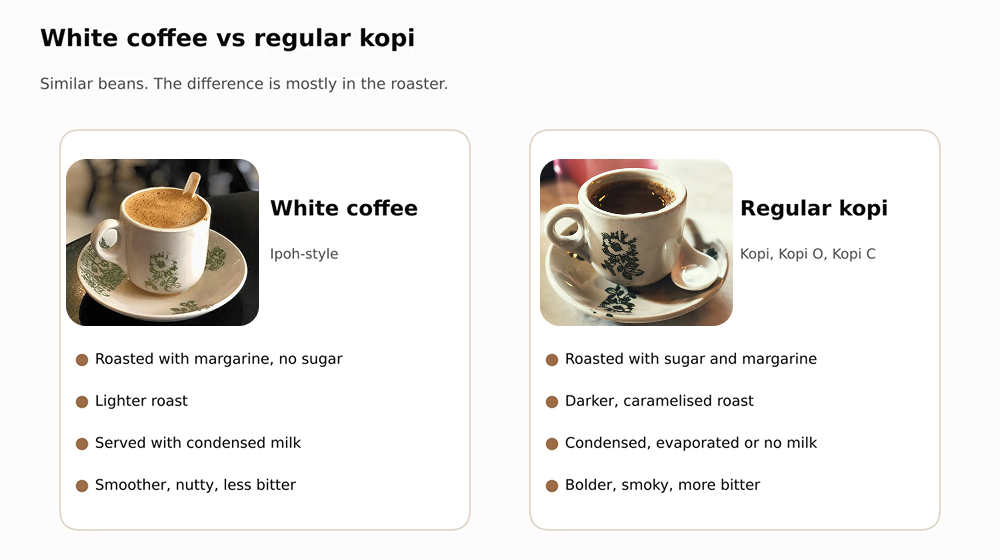
Because the beans aren’t caramelized with sugar and the roast is lighter, the drink is usually described as smoother and less bitter than kopi. The margarine adds a buttery, nutty note, and the condensed milk gives it body.
Hot, it’s frothy and rich. Iced, it’s lighter and more refreshing, a popular choice on a humid afternoon.
Not when you compare them fairly. A 2026 fact-check by The Star concluded that white coffee does not have more caffeine than regular coffee. A kopi O and a cup of kopi putih from the same kopitiam usually use the same beans, so they contain roughly the same caffeine.
What really decides caffeine is the bean. Robusta green beans contain about 1.2–2.4% caffeine by dry weight, compared with 0.9–1.5% for arabica, according to a review in the journal Foods. A Universiti Malaysia Sarawak study of seven local coffee products also found arabica had the lowest caffeine. Our guide to Arabica vs. Robusta coffee beans explains the difference in more detail.
Roast level matters less than most people think. In a 2024 study in Scientific Reports, dark roasts brewed under identical conditions generally had slightly less caffeine than light and medium roasts. Ipoh’s roast is medium, so the effect is small.
Where you will notice a difference is between brewed coffee and sachets.
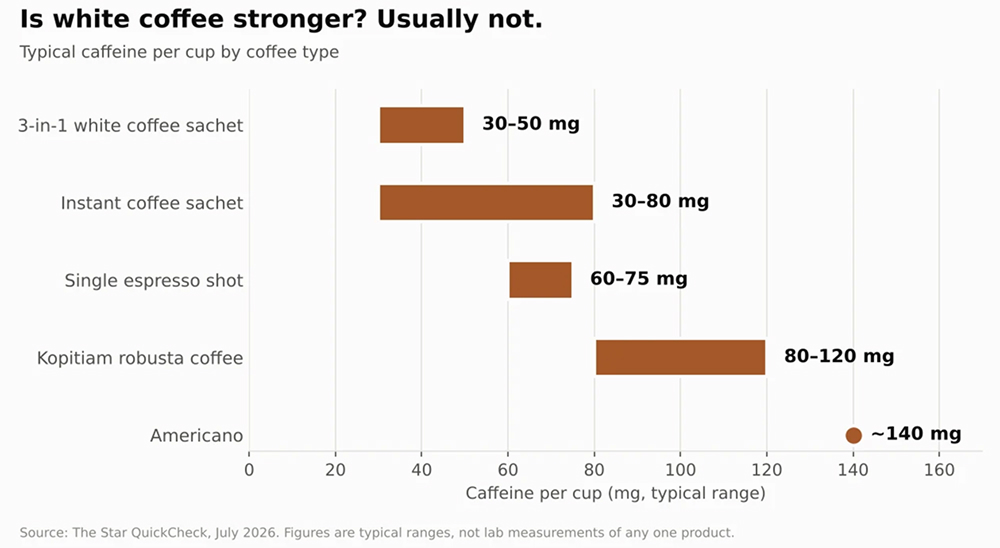
The Star puts a 3-in-1 sachet at about 30–50 mg of caffeine, because most of the packet is creamer and sugar. Traditionally brewed robusta kopitiam coffee comes in at about 80–120 mg per cup. If you want a bigger kick, choose brewed kopi or a robusta-heavy blend, not a sachet. For more on this, read our guide to caffeine in coffee.
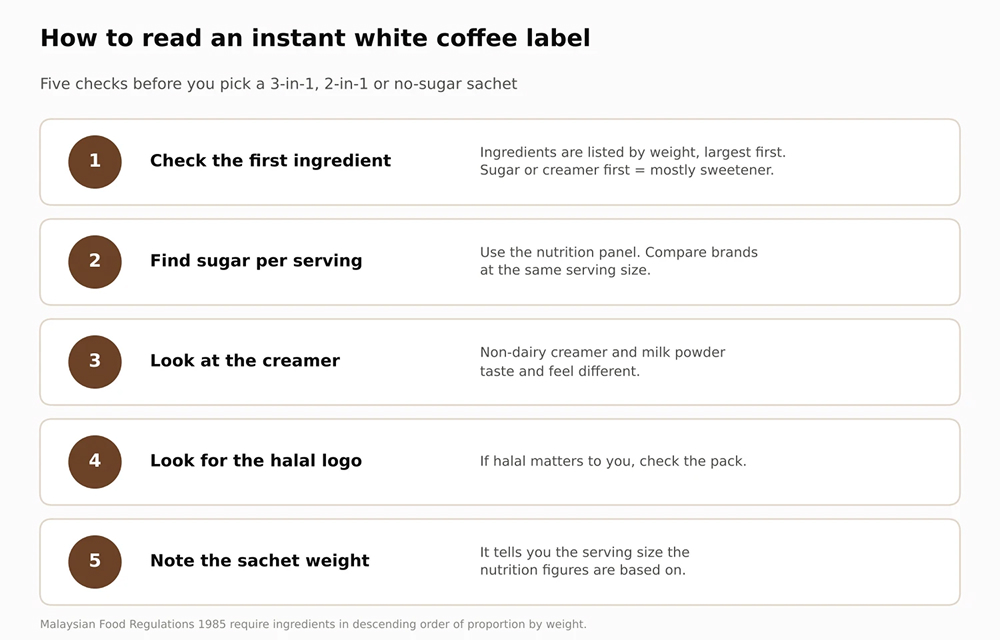
For many Malaysians, the drink at home comes from a sachet. The words on the pack tell you what’s inside.
Under Malaysia’s Food Regulations 1985, ingredients must be listed in descending order of proportion by weight, as the Ministry of Health labeling guideline sets out. That makes the label your best comparison tool.
| If you want… | Look for |
|---|---|
| The classic sweet kopitiam taste | A 3-in-1 sachet |
| Creaminess with no added sugar | 2 in 1, or “no sugar added” |
| A bolder coffee flavor | A “strong” variant, or less water |
| A good iced cup | A strong or creamy variant, dissolved in a little hot water before adding ice |
Mister Coffee has been making coffee in Malaysia since 1982, and our instant coffee range includes three options for different tastes:
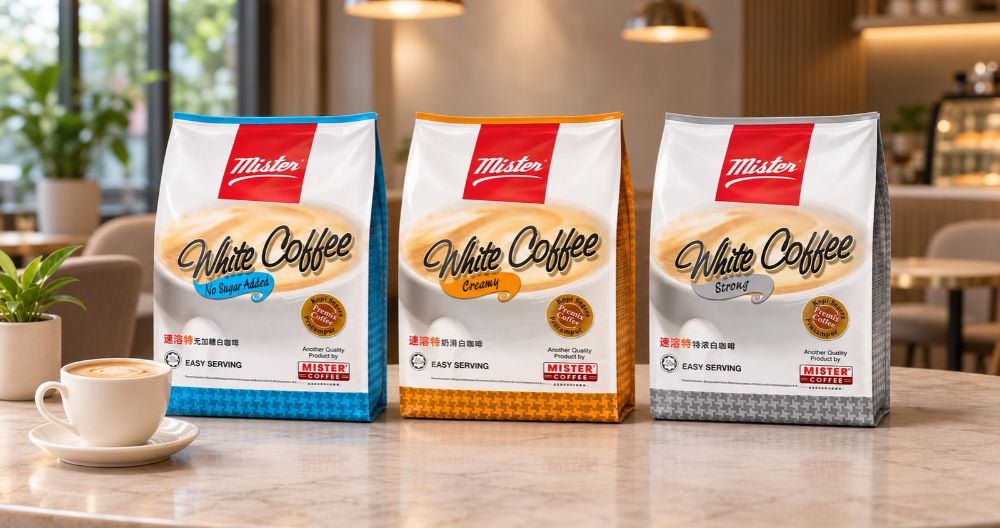
For an iced cup, stir one sachet into a small amount of hot water until fully dissolved, then pour it over a glass packed with ice and top up with cold water or milk to taste.
Mister Coffee’s materials and production processes are halal-certified by the Halal Professional Board and JAKIM. You can read more in our article on halal-certified coffee in Malaysia.
Want to compare other sachet styles? Our guide to buying instant coffee in Malaysia covers what to look for.
The traditional Ipoh version contains coffee beans roasted with margarine and no sugar, brewed with hot water and mixed with sweetened condensed milk. Instant versions replace the brewed coffee with instant coffee, creamer, and, in 3-in-1 sachets, sugar.
It’s kopi putih: Ipoh-style coffee: beans roasted with margarine but no sugar, served with condensed milk. It originated in Ipoh’s kopitiams and is now sold widely as instant sachets.
The roast. Regular kopi beans are roasted darker with sugar and margarine, which gives a bolder, more bitter cup. Ipoh-style beans are roasted lighter without sugar for a smoother, nuttier taste.
No. It doesn’t have more caffeine than regular coffee made from the same beans. Caffeine depends mainly on the bean type, and robusta has more than arabica. A 3-in-1 sachet usually contains less caffeine than brewed kopi.
No. The beans are regular coffee beans roasted to a medium color. The name is a translation of its Chinese name, and the creamy color comes from the condensed milk.
No. A flat white and a latte are espresso with steamed milk. The Ipoh version uses margarine-roasted beans and condensed milk, so it tastes sweeter and nuttier.
The beans are roasted without sugar, but the condensed milk is sweet. 3-in-1 sachets also contain added sugar. Choose a 2-in-1 or “no sugar added” version if you want to control sweetness.
A 3-in-1 sachet contains instant coffee, creamer, and sugar. A 2-in-1 sachet contains only instant coffee and creamer, so you add sugar yourself if you want it.
Yes, and many people prefer it that way. Dissolve the coffee in a little hot water first, then pour it over plenty of ice.
Mister Coffee’s materials and production processes are halal-certified by the Halal Professional Board and JAKIM.
White coffee isn’t a special bean or a pale roast. It’s a Malaysian roasting tradition, born in Ipoh’s kopitiams, that trades sugar-caramelised bitterness for a smoother, nuttier cup. And it isn’t stronger than kopi, just different.
Ready to try it at home? Browse the Mister Coffee instant coffee range and pick the one that fits your taste.
Building your own coffee brand? Mister Coffee also offers OEM and private label coffee manufacturing, including instant coffee.


